Wholesale Electricity Prices Drop 50% Amid Renewable Energy Surge
In the June quarter, wholesale electricity prices across Australia’s primary grid experienced a sharp decline of nearly 50%, driven by a notable increase in renewable energy production reaching unprecedented seasonal levels, alongside a decrease in coal output and the lowest gas generation figures seen in 23 years.
The configuration of the grid and the falling prices were positively affected by a substantial rise in battery storage both at the grid level and in residential settings, with more households adopting battery technology supported by federal government incentives.
Significant Price Drops Observed
The Australian Energy Market Operator (AEMO) announced that average wholesale prices in the National Electricity Market (NEM), which encompasses the eastern states and South Australia, have fallen to their lowest levels for the June quarter since 2020. This represents a 47% decrease compared to the same period last year, with an average price of $74 per megawatt hour (MWh).
AEMO attributed this drop to a record renewable energy contribution of 42.1%, noting that renewables typically yield their lowest performance in the June quarter, alongside a 5% decrease in coal generation and a striking 30% plunge in gas-powered output, marking the lowest June figures since 2003.
Impact of Battery Storage
Gas generation was notably sidelined by an influx of large-scale batteries, which added 3.9 gigawatt hours to the grid and doubled overall capacity to 9 gigawatts. Additionally, household battery capacity surged by 41% to 3,283 MWh.
Violette Mouchaileh, AEMO’s head of policy and corporate affairs, commented on the ongoing changes in Australia’s energy market, stating, “Record renewable generation, combined with growing battery storage and consumer energy resources, continues to reshape Australia’s energy markets.” She highlighted how these advancements influence demand patterns, enhance system reliability, and contribute to a larger supply of affordable energy.
Grid-Scale Batteries and Their Role
The Quarterly Energy Dynamics (QED) report noted how grid-scale battery systems are effectively utilising excess solar energy for storage during the day and then discharging this energy during peak evening demand periods. The average daily charging and discharging figures have increased by over a gigawatt compared to the previous year.
Moreover, the role of grid-scale batteries has altered price-setting mechanics, with their charging and discharging determining prices in 36% of dispatch intervals, a rise from just 17% in the same quarter of 2025.
State-by-State Price Changes
Victoria saw the most significant drop in wholesale electricity prices, decreasing by 60% to reach an average of $56/MWh. New South Wales (NSW) followed, with a 53% reduction to $75/MWh, while Queensland’s prices dropped by 44% to $67/MWh. Tasmania, which largely depends on hydroelectric power, experienced a 39% decrease, reaching $86/MWh.
South Australia, recognised for its leading renewable grid with a yearly average comprising 75% wind and solar energy, also recorded a 38% decline in wholesale prices, settling at $86/MWh. This occurrence transpired despite several days of severe wind shortages, cold weather, and transmission bottlenecks that hindered imports from neighbouring states.
During a couple of days noted for extreme weather, prices soared above $20,000 per megawatt hour due to gas and diesel generators recovering their position in the market. This surge alone contributed an additional $13/MWh to the average price for the quarter. In the absence of these high-price events, wholesale prices in South Australia would have almost halved from the previous June quarter to $73/MWh.
International Recognition and Grid Changes
The substantial decrease in prices within Australia’s primary grid has garnered acknowledgment from the International Energy Agency, which noted that Australian wholesale power costs in the June quarter were lower than the averages across the EU, Japan, India, and the United States.
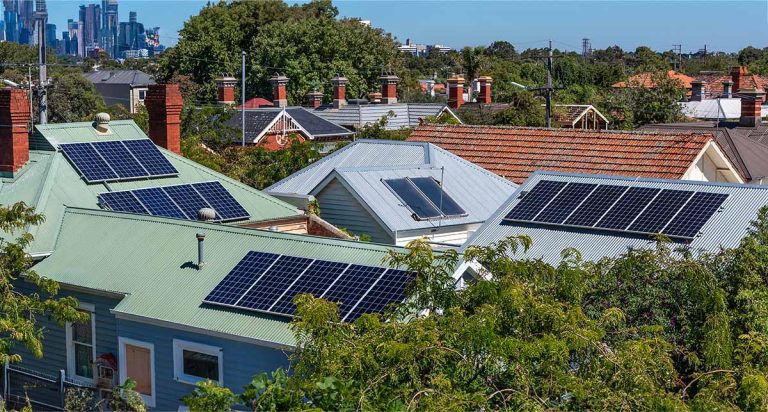
AEMO also indicated that the grid’s configuration is evolving swiftly, with operational demand during daytime hours experiencing growth rather than the expected decline. This surge is attributed to increased home battery charging, higher industrial demand, and the load from data centres, all of which have outpaced the increase in distributed solar photovoltaic (PV) output.
With this transformation, daily demand profiles are shifting, with less reliance on evening peak supply as more households utilize battery systems to meet their energy needs after sunset, coupled with milder weather conditions that alleviate heating demands.
Interestingly, the use of battery storage has influenced wholesale prices on several occasions, with an average price of $107/MWh, considerably lower than the $452/MWh charged during the same quarter last year, positioning battery storage as a more affordable option than gas.