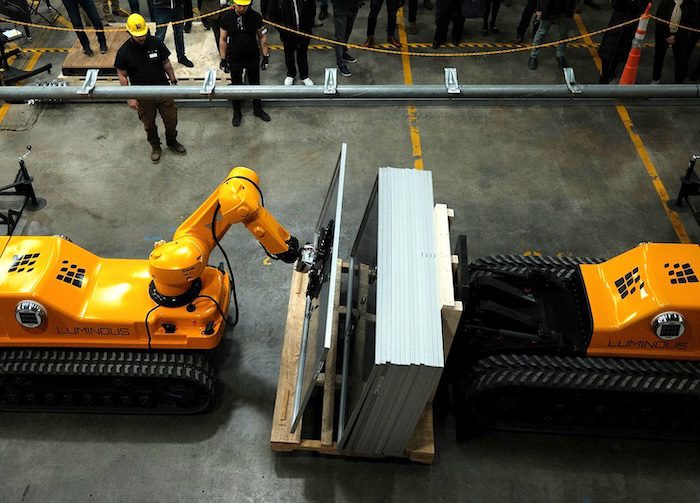
Robots Communicate to Build Solar Farms in Australia
Luminous Robotics, a company making strides in solar-building technology, is now at a point where they could, at least in theory, manage the construction of significant portions of a solar farm from their offices in Boston. This innovation marks a pivotal development in the deployment of solar energy infrastructure.
The firm is introducing a system known as “synchronised heterogenous fleet autonomy,” which facilitates both remote control and communication between robots, in their operations across Australia. Their innovative Lumi device is designed to autonomously handle solar panels, placing them onto trackers efficiently.
Successful Trials and Future Prospects
Recently, Luminous has successfully conducted trials funded by the Australian Renewable Energy Agency (ARENA) at two solar projects that have already been completed, with a third trial wrapping up and plans for a large-scale project on the horizon. Although they have the technology to monitor these remote operations, they still adhere to strict regulations.
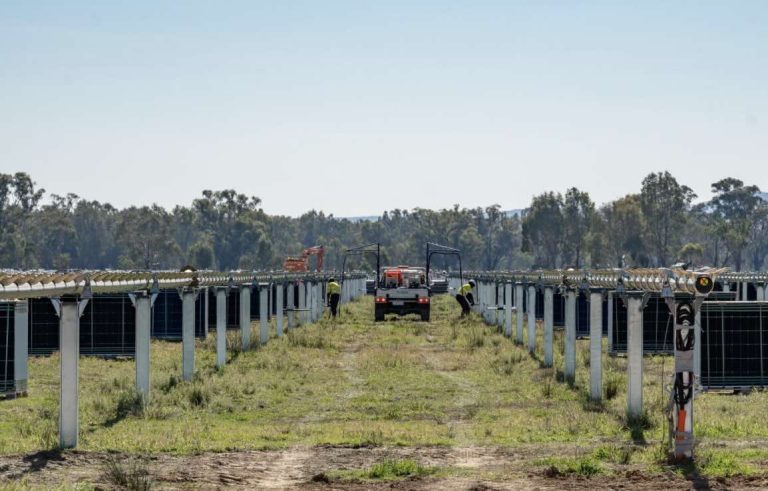
Jay Wong, CEO of Luminous Robotics, explains, “Our machines are autonomous, however, we do deploy them with safety technicians nearby the robots, akin to the early days of autonomous vehicles. This approach helps us comply with construction safety protocols as outlined by our partners.” He also pointed out their capability to oversee their fleet from anywhere globally, stating that he can monitor their operations in New South Wales even while composing this email.
Advancements in Robot Technology
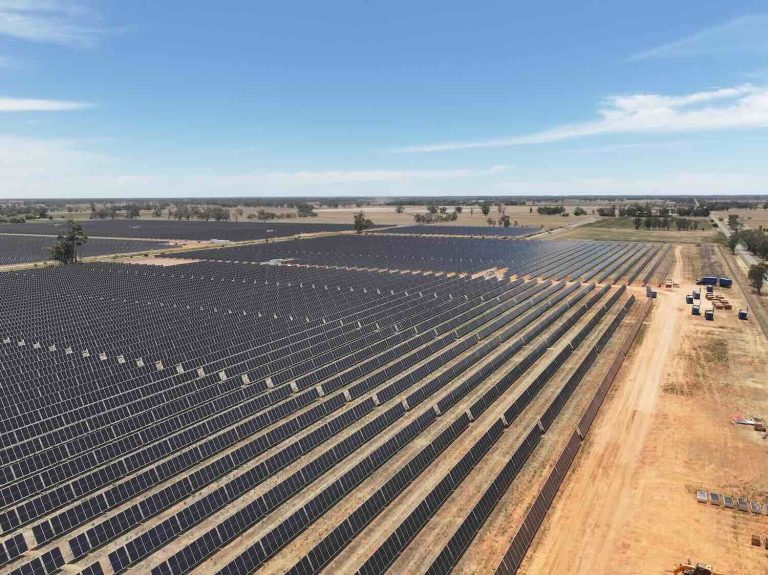
The Boston-based firm has obtained funding to trial their innovative “empathy first” Lumi robot technology at various solar projects, including the 350 megawatt Culcairn solar farm in New South Wales and the 250 megawatt Goorambat East project in Victoria. Earlier this year, they completed the installation of panels at the 80 megawatt Lancaster solar project in Victoria.
Wong mentioned they are currently engaged in a substantial project exceeding 500 megawatts, although he is unable to disclose specifics at this time. The Lumi robots, much like how robotic vacuum cleaners map a home, will create a detailed digital representation of a solar site.
“This entails our robots working concurrently to map the site out, creating a comprehensive digital twin of the ‘as built’ environment – every panel installed is tagged with imaging capturing its condition before and after installation, and precisely geolocated using GPS,” Wong elaborated.
Competition in Robotic Solutions for Solar Construction
Various players in the industry are exploring robotic solutions for solar farm construction, including Australia’s national science agency CSIRO with its repair bot Bear, and Chinese firms like Trinasolar and Leapting, which offer alternatives to the Lumi units. Other companies, such as Built Robotics and Nexttracker, are developing robotic pile driving technology.
For instance, Built Robotics has initiated tests of its devices on a solar project for Fortescue in the Pilbara region. Meanwhile, Nexttracker announced plans last year to trial a robotic pile driver in Australia. Both companies, along with solar developers, argue that these robots help alleviate the shortage of human labourers, concurrently allowing skilled workers to be redirected to different tasks.
Leapting promotes its pick-and-place robots as capable of performing the work typically assigned to three to four human workers. In addition to addressing labour shortages, automation also presents economic advantages; robots are generally more cost-effective and efficient than human teams, especially in challenging conditions.
ARENA aims to drive down the cost of large-scale solar energy to less than $20 per megawatt hour by 2030, alongside an expectation of a 30% enhancement in cell efficiency.