Victoria Coalition to Review Transmission Plans and Emphasize Renewables
David Davis, who could become Victoria’s next energy minister if the Liberal-Nationals coalition emerges victorious in the upcoming state election this November, has stated his intention to initiate a “short, sharp and independent” review of the state’s extensive transmission plan, although he acknowledges that renewable energy sources will be “the single biggest component” of generation.
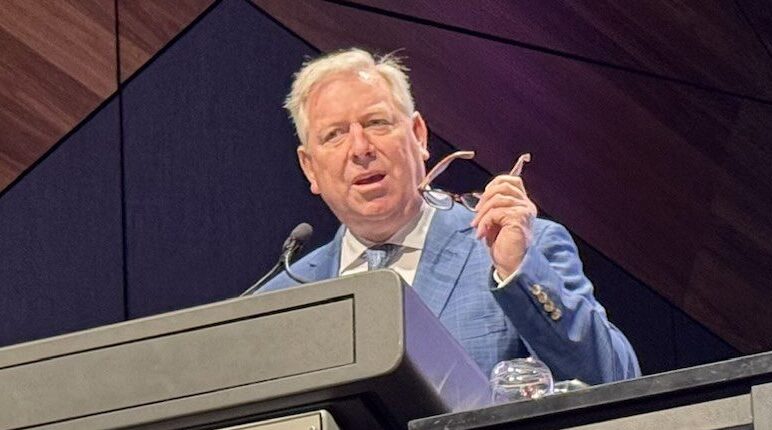
Delivering his remarks at the All Energy 2026 conference in Melbourne on Wednesday, Davis refrained from unveiling new policies but expressed generally accommodating comments to an audience largely comprised of supporters of the shift away from fossil fuel reliance.
Emphasising Energy Security
Davis highlighted the significance of the electrification agenda, describing it as “very important,” while also stressing that “the energy security agenda is incredibly important” as well. Acknowledging the achievements of the 12 years under Labor’s governance in Victoria, he noted the extensive rollout of solar energy, the increase in wind capacity, and advancements in battery and storage capability, all of which have transformed much of the state’s power grid.
However, most of his address, coupled with brief comments afterwards to Renew Economy, included criticisms of the speed and breadth of the transition in Victoria, underscoring the necessity for greater use of gas in the energy mix.
Concerns Over Future Energy Supply
Davis did not clarify how increasing the use of the costly fossil fuel would drive down prices, nor did he address issues regarding climate change or emissions except in his concluding remarks. The pressing energy concerns facing the state include the anticipated closure of the Yallourn coal-fired power station, which produces 1.48 gigawatts, by mid-2028, making the development of new generation capacity a top priority.
“Our aim is to enhance living standards while managing energy costs and their effects on families,” Davis stated. “We are profoundly aware of the necessity to ensure the reliability of the power supply as well as the need to reduce emissions.” He added that those in attendance at the conference play a crucial role in facilitating a smoother, faster, and more affordable energy transition.
Timeline for Transmission Review
When questioned about the timeline for a transmission review under a Liberal-led government, Davis indicated he had not set a precise timeframe but stressed his intention to act quickly to avoid delays of the kind attributed to the previous government. “Many projects are already eight years behind schedule,” he commented, defending his critique of the preceding Labor government’s timeline.
In his address, Davis referenced a recent article in the Herald Sun that highlighted what it described as a leaked “confidential briefing paper” on energy prepared for government officials, irrespective of which party prevails in the November election. Titled “Dire gas shortage warning,” the article reported on the expectation that Victoria’s gas demand will surpass its annual production by 2029. Should these shortages remain unaddressed, significant repercussions for households and the state’s economy could follow, according to the report.
Predictions from the AEMO Report
This forecast aligns with the recent gas statement of opportunities published by the Australian Energy Market Operator (AEMO). It indicates that from 2030 onwards, projected supply deficiencies under various weather conditions will necessitate additional supply beyond what is currently acknowledged as committed, or increased investment in demand-side strategies to mitigate gas requirements. Moreover, a steady decline in gas consumption is anticipated across residential and small commercial sectors, reflecting a reduction in active connections and the anticipated impact of electrification.
The AEMO report also noted that bans on new gas connections in Victoria and the Australian Capital Territory are contributing to lower projected gas usage, even in the face of economic growth and new housing, with an estimated 65% of this decline occurring in Victoria.
Future Gas Policy Plans
The Liberals have indicated that reversing the gas connection ban will be among their top priorities should they assume government, with pledges to “reverse Labor’s gas appliance bans and invite gas producers to propose conventional gas exploration opportunities” as a means to lower energy costs for Victorian households and businesses. However, extracting gas remains expensive, with limited promising fields and a noticeable absence of major firms engaging in the bidding for drilling rights.
In a recent announcement, Labor Premier Ben Carroll confirmed that the government has granted a production licence to restart the Patricia-Baleen gas fields located off Victoria’s Gippsland coast. “We recognise that Victoria’s gas supplies are dwindling. That’s why Labor is committed to securing our existing supply and exploring new sources of gas,” Carroll stated. This licence has been allocated to Cooper Energy, a subsidiary of Amplitude Energy, with the project expected to deliver an estimated 15 petajoules of gas over its lifespan—equating to 7% of the total gas consumption in Victoria from the previous year.