Australia’s New Transmission Loop to Transform Electricity Flow Across Three States
The final phase of Australia’s largest transmission initiative, a 900 km grid enhancement, is undergoing operational trials as it gears up for full capacity expected by the end of next year. This groundbreaking project is set to transform the flow of electricity among three key states.
Recently, the Australian Energy Market Operator (AEMO) announced a significant milestone for the $4.1 billion Project EnergyConnect—a unique interconnector that establishes a vital new link between South Australia, Victoria, and New South Wales.
Connecting States with New Capacity
This two-stage project links Robertstown in South Australia to Wagga Wagga in New South Wales, adding around 800 megawatts (MW) of bidirectional capacity. ElectraNet and Transgrid are the major network companies responsible for delivering this project on their respective sides.
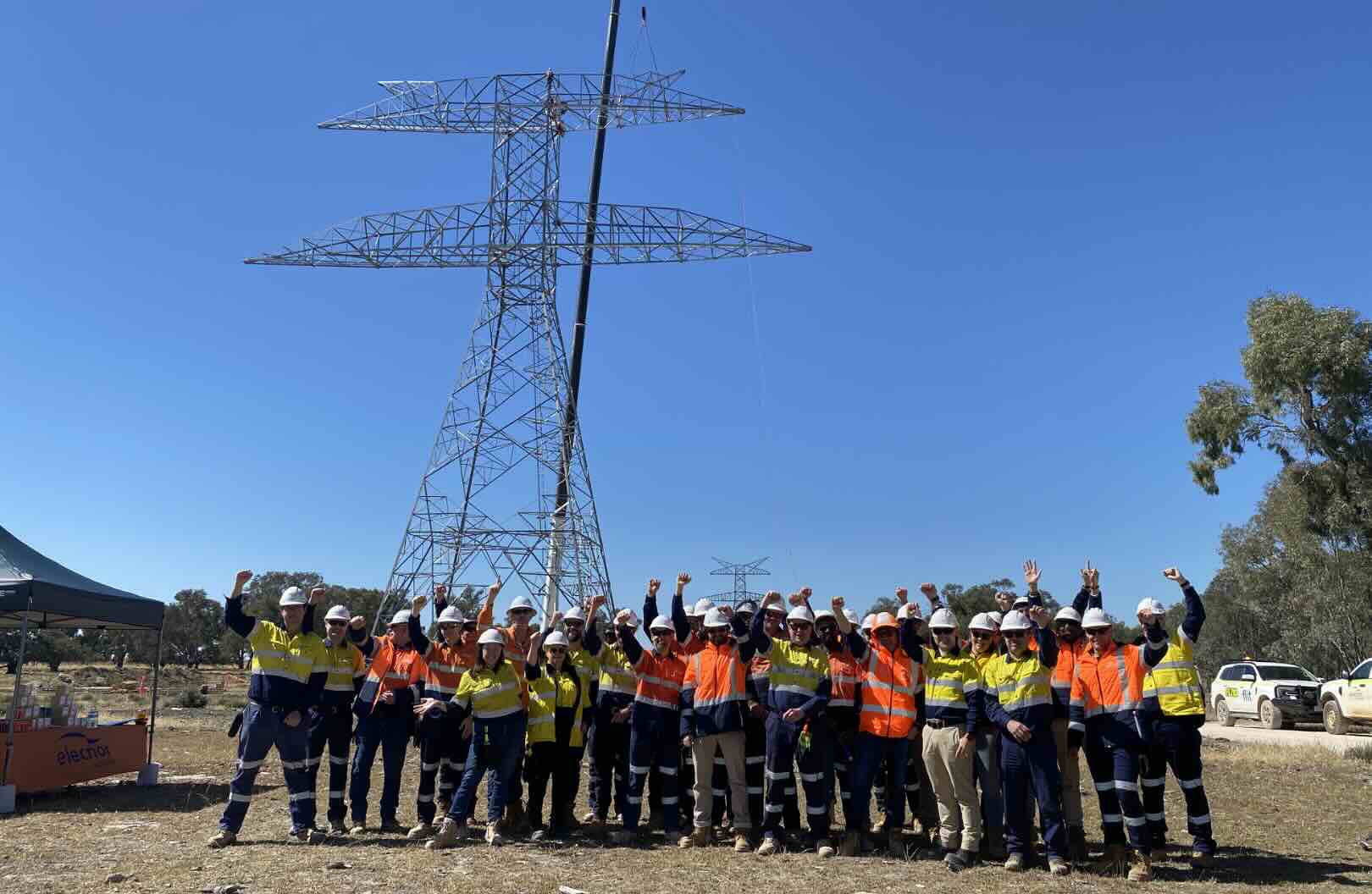
According to AEMO, operational testing for stage 2 of Project EnergyConnect—which covers the 700 km section in NSW, featuring over 1,500 towers—will commence this month. Energy transfer capabilities will be increased as testing opportunities arise, with full commissioning anticipated by the close of 2027.
A Historic Advancement for the National Grid
For Australia’s primary grid, the National Electricity Market (NEM), this represents a pivotal moment as it marks the first new interconnector established between states in 15 years. “Implementing a new transmission line like Project EnergyConnect demands extensive preparation across various facets including power system operations, market regulations, and industry readiness,” said AEMO’s group manager of operations resilience, Teresa Smit, in a recent statement.
As the system and market operator for the NEM, AEMO will need to revise market, settlement, dispatch, and registration protocols to accommodate this new interconnector and the added complexities arising from a looped network.
Boosting Reliability and Transitioning to Renewables
This development is also a key pillar for Australia’s energy transition, enhancing security and reliability within the NEM. It is vital for South Australia to achieve its goal of 100% net renewable energy and will be instrumental in facilitating the phase-out of coal-fired power in New South Wales.
According to Smit, the ongoing expansion of the existing 44,000 km transmission network throughout the NEM is essential to support a near doubling of electricity consumption projected by 2050 as households, businesses, and industries increasingly electrify and as ageing coal-fired power plants retire. “Transmission networks are crucial for connecting new energy generation and storage systems to the grid, facilitating the efficient transfer of electricity from generation sites to where it is most needed,” she explained.
Industry Response and Future Prospects
The official commissioning of the new interconnector was celebrated on LinkedIn by various industry experts, with one individual heralding it as the dawn of “a new era for Australia’s NEM.” The Project EnergyConnect has officially entered the NEM Dispatch Engine with initial transfer capacity set at ±150 MW, while the complete 800 MW bidirectional capacity is expected to be gradually unlocked.
For South Australia, this could signal a significant change. Long-standing issues such as severe renewable curtailment and negative pricing—stemming from extensive rooftop solar and wind farm proliferation—may diminish as capacity improves. Consequently, negative pricing during midday hours might become less of a common occurrence, and evening price surges could also lessen.
As South Australia prepares for a substantial increase in hybrid solar projects following nearly eight years of utility-scale solar expansion, the state is poised to establish itself as a central energy hub within the NEM.
The Journey to Completion
Project EnergyConnect was first proposed in AEMO’s 2020 Integrated System Plan (ISP) and has encountered a somewhat tumultuous journey regarding planning, regulatory approvals, and construction, particularly on the New South Wales side. While the South Australian segment—a 206 km line from Robertstown to the SA-NSW border—was completed as scheduled and within budget by late 2023, the NSW section has faced a myriad of challenges that have escalated the overall project cost from $1.8 billion to $3.6 billion and delayed its completion.
The Australian Energy Regulator has thus far resisted Transgrid’s attempts to recoup approximately $1 billion in additional expenses through its revenue determination for the 2023-28 period. Transgrid attributes these increased costs to factors beyond its control, citing a “contract failure” with its engineering, procurement, and construction partner, Elecnor.
Significance for Renewable Energy Goals
“The energisation of EnergyConnect caps off one of the nation’s most significant transmission ventures and signals a defining step towards Australia’s clean energy future,” remarked Transgrid CEO Brett Redman when construction was finalised and the NSW line was activated. He highlighted that the project would empower consumers by granting them access to more affordable energy sources such as solar and wind.
This project plays a crucial role in Australia’s climate change objectives as the country shifts away from coal-fired power towards renewable energy. Transmission developments are often viewed as necessary for facilitating Australia’s transition to renewables, despite being contentious due to their financial impact and effects on landholders and farmers in the paths of the new lines.
In Victoria, the future of two significant transmission initiatives, VNI West and Western Renewables Link—both linked to EnergyConnect—remains uncertain, with outcomes likely to be influenced by November’s state elections. In this context, the latest milestone for Project EnergyConnect holds even greater significance.