Australia’s Grid Sets Record for Battery-Stored Energy Amid Solar Surge
Australia’s National Electricity Market (NEM) has set a remarkable new record for battery-stored energy, demonstrating the growing impact of large-scale battery projects that are increasingly integrating solar energy during the day to provide support during peak evening demand.
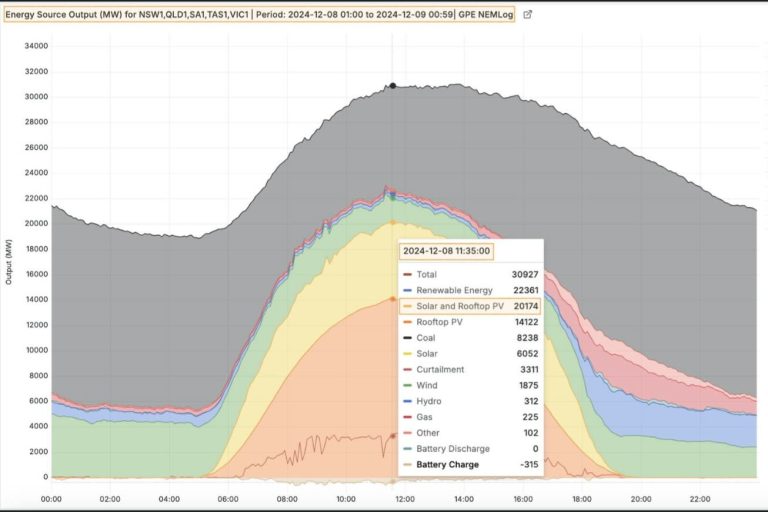
The latest milestone was highlighted by Geoff Eldridge from Global Power Energy on LinkedIn, revealing that the NEM reached an impressive instantaneous high of 20.17 gigawatt-hours (GWh) of battery-stored energy at 4:15 pm on Friday. This achievement is visually represented in the GPE NEMLog graph.
Rapid Growth in Battery Storage
Eldridge noted that the NEM’s maximum recorded battery storage has surged by an astonishing 203 per cent over the past year, climbing from a previous record of 6.66 GWh set on 5 November 2022. This swift growth underscores the rapid evolution of energy storage capabilities in Australia.
In New South Wales, a notable record was also established as battery-stored energy reached 8.36 GWh, significantly up from the 2.9 GWh recorded on 8 October 2022, marking a remarkable 188 per cent increase.
Solar Energy Milestones
Additionally, several utility-scale solar records were achieved, with instantaneous solar availability hitting 10,561 MW on Friday, a substantial rise from the previous high of 9,410 MW set on 17 October 2022, reflecting a 12 per cent increase, according to Eldridge.
Despite these impressive advancements in battery storage and solar availability, there was still a considerable amount of solar energy that went unutilised that day. GPE NemLog reported a total of 41.36 GWh of generation was curtailed, comprised of 26.67 GWh from solar and 14.69 GWh from wind sources. In New South Wales alone, 15.68 GWh of renewable generation, predominantly solar, was curtailed on Friday.
Eldridge remarked on LinkedIn, “Substantial renewable generation continues to be curtailed, including during positive-price intervals.” He emphasised that while batteries at both utility and consumer levels, along with other flexible demand solutions, can assist in absorbing available generation, factors like transmission constraints, local dispatch conditions, and the strategic placement of storage also play crucial roles.
The challenge now lies in optimising the NEM’s capacity to harness both generation and storage effectively, moving beyond simply measuring the amount of energy produced to exploring the efficiency of its usage.