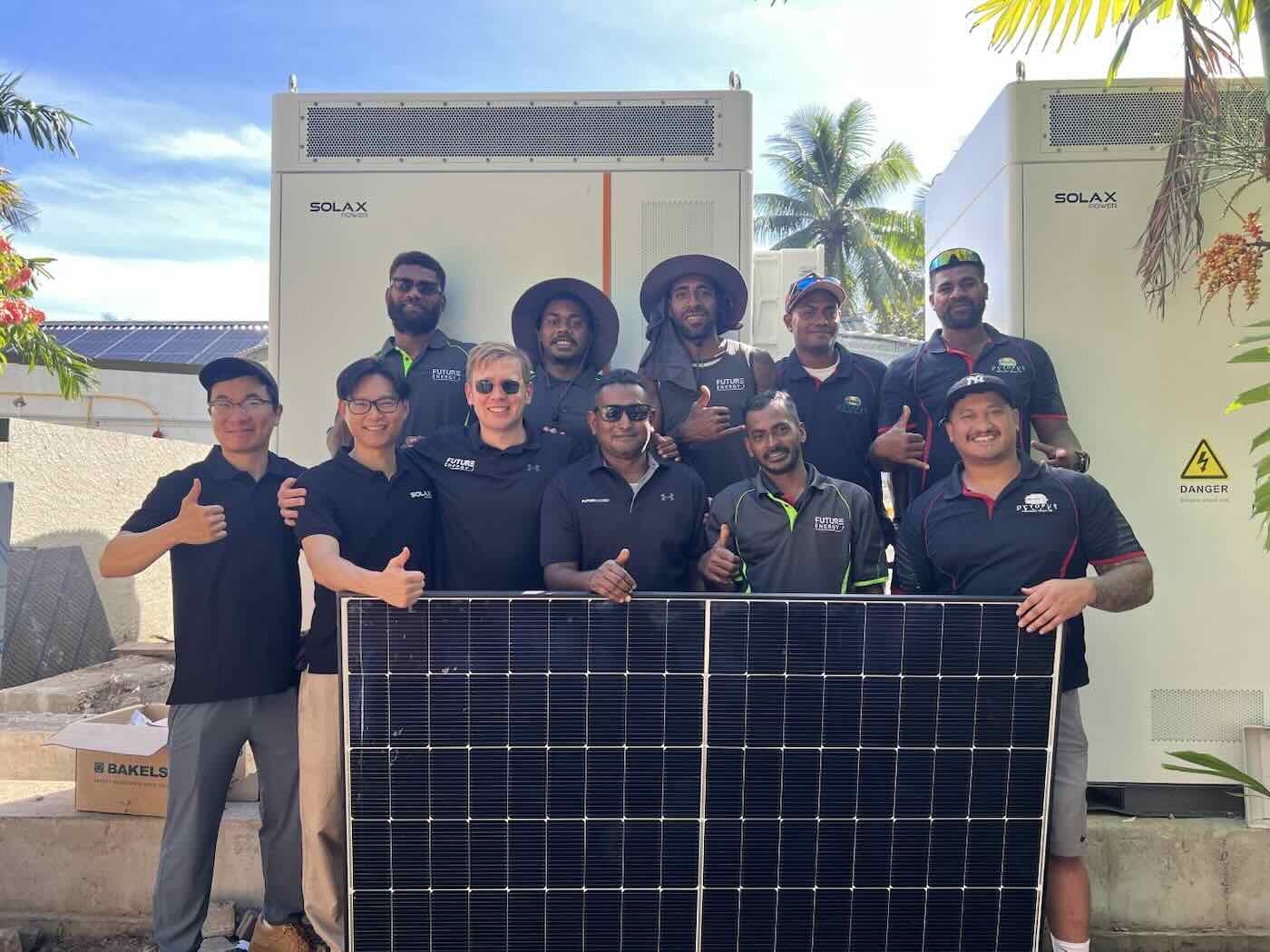
Lessons from Fijian Electricians on Off-Grid Solar Systems
When I arrived at the Yasawa Islands in Fiji to oversee a 1.6 megawatt-hour off-grid solar battery setup for three isolated resorts, I believed I understood the requirements of the task ahead.
The plan was straightforward: commission the system, provide some maintenance training, and then return home.
However, as I found myself on a secluded island surrounded by five local electricians and a pressing timeline, I quickly realised that one of the most daunting aspects of the project wasn’t linked to the technology itself.
The Real Challenge
The functionality of the system was never in doubt. The real concern lay in whether the local electricians, tasked with operating it, could successfully manage it months later, perhaps when unexpected issues arose and I wasn’t there to assist.
This presented a completely different challenge that couldn’t be resolved merely by providing a manual.
Interestingly, the five electricians involved in the Yasawa project had no previous experience with solar technology. This lack of knowledge was understandable given that Paradise Cove, Blue Lagoon, and Octopus Resort had relied solely on diesel generators before. Consequently, there had been no demand for solar skills.
Additionally, their starting point was far removed from what one would expect in a commercial installation in cities like Melbourne or Brisbane. The critical knowledge commonly assumed in the Australian market — such as safety protocols, system integration, and identifying faults — simply wasn’t present.
Rethinking Knowledge Transfer
As a result, we had to completely rethink our approach to knowledge transfer. Detailed technical explanations didn’t resonate, but step-by-step demonstrations proved effective. The electricians quickly grasped the concepts as we worked side by side, turning each site visit into a valuable training opportunity, and using any faults as moments for teaching.
A memorable incident occurred during installation when a door on one of the equipment cabinets was scratched in transit. Given the absence of cranes on the island, the locals had to manually transport items using forklifts or tractors, leading to this minor oversight.
In a coastal tropical region where saltwater, extreme humidity, and heavy rains prevail, even the slightest oversight can escalate into significant issues. That scratch posed a risk of rusting and corrosion which could compromise the entire cabinet.
While we planned to supply specialised paint to reseal the cabinet, our primary objective was to educate the local team on what to monitor, what required fixing, and how to carry out repairs independently.
Empowering Local Talent
This was our aim: we weren’t just commissioning a solar system; we were empowering the local workforce to maintain it.
By the time our project in Yasawa was fully operational, those five electricians had gained the skills to manage and maintain a 1.6 MWh battery storage system independently.
This approach ensured that long-term capabilities were established from day one, leading to a genuine reduction in reliance on costly external support — a significant advantage in a region where bringing in specialist technicians can be prohibitively expensive and logistically challenging.
The success of a remote deployment should not be measured solely by the commissioning date but rather by the system’s resilience when issues arise at inconvenient times, like 7:30 PM on a Thursday, while resort guests are dining in darkness — and when the nearest qualified technician is a great distance away.
Relevance to Local Projects in Australia
Transferring knowledge effectively is crucial to ensuring that the system becomes truly self-sufficient. If this transfer fails, you risk creating a new dependency — effectively trading one resource for another that cannot be produced locally.
What implications does this have for local projects in Australia? Indeed, we face similar challenges.
Remote communities, off-grid installations, rural hospitals, and island infrastructures all exist where the distance makes ongoing external support impractical and costly.
The Yasawa project exemplifies the importance of going beyond mere commissioning; it highlights the necessity of genuinely building capacity within the local workforce.
While the technology used is already established — and that part of the task straightforward — the real challenge lies in ensuring that the local personnel trust, understand, and can maintain the system long after the installation is complete.
You simply cannot ship that expertise in a container; it requires a personal investment of time and effort.
— Danny Fang is a senior field application engineer at SolaX Power Australia.