Hanson and Rinehart’s Misguided Attacks on Renewable Energy
A fascinating post has surfaced on the Hancock Prospecting website, the mining company that has contributed significantly to Gina Rinehart’s status as Australia’s wealthiest individual. The article asserts that “Mining is essential to achieve net zero,” positing that mining plays a critical role in securing the minerals necessary for daily life and in constructing renewable energy projects.
It states, “The first step in the supply chain to create solar panels, wind turbines, and electric vehicle batteries starts with mining companies like Hancock, Atlas, and Roy Hill.” Hancock Prospecting emphasizes its adherence to scientific principles and regulatory compliance, pledging to align with government goals for emission reductions of 43 per cent from 2005 levels by 2030 and to reach net zero by 2050.
Contradictory Public Messages
However, this narrative diverges sharply from the messages Rinehart conveys in her public engagements. Reflecting a more sceptical perspective, Rinehart frequently criticises net zero initiatives, proposes their cancellation, and refers to “toxic” solar panels, asserting that such projects, along with wind turbines and battery storage, are causing harm to significant portions of the environment—a sentiment echoed by Pauline Hanson, leader of the rising One Nation party supported by Rinehart.
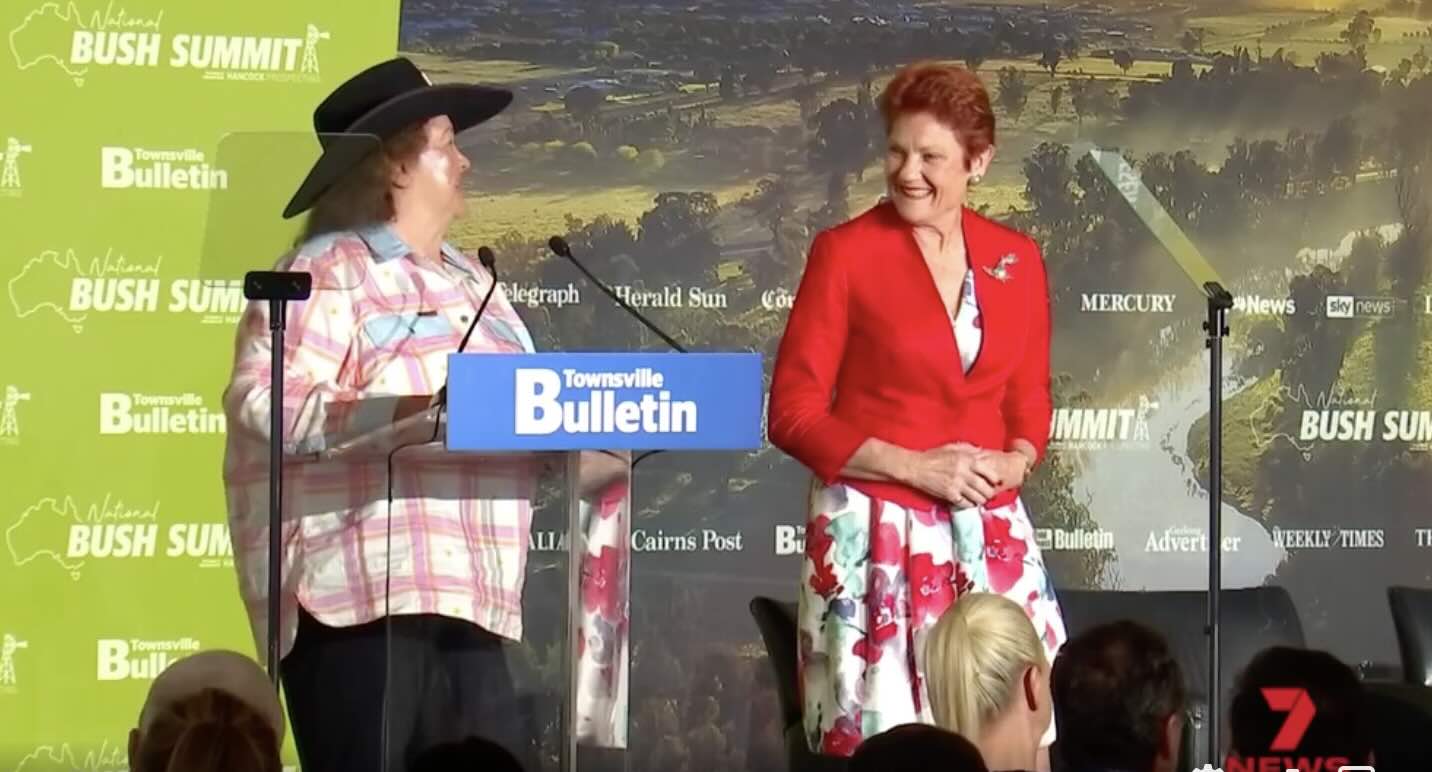
During the Hancock-hosted Bush Summit in Townsville, Rinehart expressed disappointment over utilising land for renewable energy instead of for ventures like Elon Musk’s space launchpads or a semiconductor factory in Taiwan. “We have land out near Prairie designated for toxic, asbestos riddled, bird and bat maiming, bird and bat killing wind towers. What a waste,” Rinehart lamented, according to her speech notes published on Hancock’s site.
One Nation’s Push Against Renewables
Hanson, who flew from Canberra to introduce Rinehart at the event, echoed similar sentiments the day before at the National Press Club, declaring, “One Nation will end this renewable energy bribery,” condemning grants, tax incentives, and government support for renewable projects which she labelled as promoting a “net zero hoax.”
Hanson targeted projects like the Snowy 2.0, suggesting she might cancel it, and made disparaging remarks about Andrew Forrest’s hydrogen ambitions, as well as criticising the Clean Energy Finance Corporation, which she falsely claimed received $200 billion from the government. Furthermore, she pledged to foster nuclear power solutions, which, as the nuclear industry indicates, would likely necessitate substantial government subsidies.
Critique of Energy Policies
The incoherence of some of these statements stands out, appearing to draw upon familiar clichés and misunderstandings evident in right-wing media outlets, while disregarding the realities of both global and local energy markets. A particularly notable aspect of Hanson’s address was its alignment with Rinehart’s ongoing criticisms of wind and solar energy, rejection of net zero as a feasible strategy, and a call for minimal government intervention.
In a keynote address at the previous year’s Bush Summit in Darwin, Rinehart derisively referred to the “great green incinerator,” aiming unspoken barbs at Forrest, who not only endorses net zero by a future date but aims for absolute zero emissions in just four years. Without naming Forrest explicitly, Rinehart questioned why iron ore miners were posting their lowest dividends in years while expending vast sums on what she termed “the great green incinerator.”
Investment in Renewables
Interestingly, despite the dismissive rhetoric from Rinehart and Hanson towards renewable technologies, two mining firms associated with Rinehart—Liontown Resources and Lynas Rare Earths—have benefited from investments in renewable energy sources. Lynas has reported a remarkable 95.7 per cent renewable energy use at its Mt Weld mine, while Liontown showcases over 80 per cent renewable energy penetration at its lithium mine.
Both companies emphasise the significant advantages gained from their renewable investments, particularly as they mitigate rising diesel costs. Meanwhile, Hanson’s pledge to halt government backing of renewable initiatives poses potential challenges for another of Rinehart’s significant investments, Arafura Resources, which has recently greenlit a substantial mining project that largely produces minerals vital for wind turbines and electric vehicles.
Contradictions and Future Implications
The funding for the Nolan’s project heavily relies on government assistance and discount loans, with Hancock Prospecting positing these minerals as essential for defence and healthcare industries—though it’s evident that the growing demand for clean energy solutions and electric vehicles fuels much of this necessity.
Rinehart has previously voiced concerns regarding “the green slush trough” of taxpayer funds, while Hanson’s claims about unfair government subsidies for renewable projects would surely surprise those in the fossil fuel sector. The Bush Summit, strongly endorsed by Rupert Murdoch’s media and echoed in mainstream press, serves as a crucial platform for Rinehart and her political allies to advocate their policies, particularly against net zero and immigration.
Rinehart has expressed her view that net zero policies undermine meaningful jobs in core economic industries, describing solar and wind projects as transient in nature—creating only temporary employment spikes during construction phases. Conversely, Andrew Forrest and Fortescue argue that transitioning to renewable energy will enhance operational profitability and unlock new business avenues, such as supplying power to data centres and developing advanced industries in Australia.
This clash of perspectives reflects a broader conflict within Australia’s energy discourse, where Rinehart and Forrest have opposing views on the energy transition, alongside criticism directed at BHP for retracting its earlier commitments. In Queensland, the LNP government’s signals towards dismantling emission regulations and renewable targets hint at a significant policy shift, which may deter developers and investors alike.
Yet, major enterprises like Rio Tinto aim to advance their operations by integrating renewable energy solutions, illustrating the complex landscape wherein market demands and political ideologies converge in the energy sector.