Australia’s 82% Renewables Target: Achievable or Delayed?
The Australian federal government remains optimistic about reaching its goal of 82 per cent renewable energy by 2030, with projections suggesting even a possible increase to 84 per cent by the decade’s end. However, they have also acknowledged the potential for delays in the rollout of new capacity due to various market challenges.
The baseline scenario presented by the Department of Climate Change, Energy and Environment sees the National Electricity Market, which serves as the country’s principal grid, achieving an 84 per cent renewable share by 2030, while New South Wales (NSW) is expected to hit 88 per cent. Currently, NSW has the lowest renewable energy share in Australia, sitting at just 36.5 per cent this year, and possesses only one wind farm under construction, although results from a significant upcoming tender are anticipated.
Industry Skepticism Regarding Targets
Despite the government’s hopeful outlook, many within the energy sector are sceptical, foreseeing obstacles that may hinder these targets. Concerns around planning delays, transmission issues, logistical challenges, and a scarcity of both supplies and workforce are prevalent, compounded by financial uncertainties stemming from fluctuating revenue and policies.
The latest climate report indicates that the Queensland LNP government is adding to the difficulty of achieving renewable targets, as it centres its efforts on prolonging the life of coal-fired power stations. This report does consider the likelihood of a shortfall in renewables, especially if the deployment of wind and solar energy is hampered by delays.
Emission Projections and Political Landscape
Should Australia delay reaching the 82% renewable target by two years, it could result in an increase of 26 million tonnes of CO2 equivalent emissions by 2030, although the difference by 2035 is projected to be minimal, at under 1 million tonnes. The assertion that achieving renewables is “not a matter of if, but when” hinges significantly on the continuation of Labor’s governance at the federal level. With a state election in Victoria looming and a NSW poll on the horizon, Labor risks losing control, with opposition parties poised to dismantle net-zero initiatives and rolling back climate policies amidst increasing issues with ageing coal infrastructure.
Challenges in Renewable Project Implementation
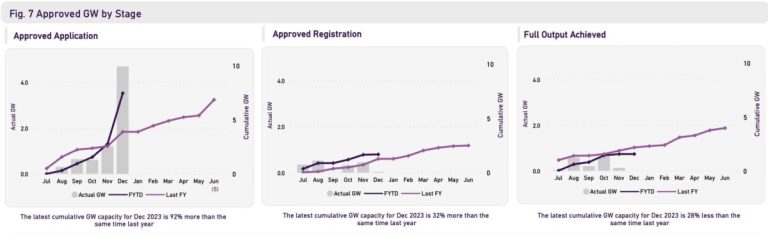
The Climate Change Authority’s latest advice, also released recently, highlights the critical need for approvals to transition from paper to actual energy generation. Although sufficient renewable energy projects have received green lights to meet the 2030 aim, construction on very few has commenced.
An analysis by IEEFA and Green Energy Markets reveals that 87.9 GW of large-scale solar and wind projects are in the pipeline, with about 38.1 GW required to fulfil the 82% renewable electricity target. As of June 2026, only 12% of the necessary capacity — around 4.7 GW — was under construction.
A further 43.6 GW in approved projects have yet to break ground due to a lack of long-term customer contracts, while 36.7 GW are still awaiting planning or environmental permits. The CCA stresses that Australia must accelerate the pace at which new large-scale renewables are being developed, advocating for a tripling of current deployment rates to achieve the 82% target.
Government’s Commitment to Renewable Future
In a parliamentary address, Federal Energy and Climate Minister Chris Bowen underscored the rapid adoption of rooftop solar, batteries, and electric vehicles as beneficial developments for households and businesses, even though supportive government policies are reportedly under review. He asserted the necessity of modernising the grid and shifting away from fossil fuels towards cleaner energy sources, emphasising not only the environmental and economic benefits but also the importance of energy independence.
Bowen highlighted that to achieve these ambitious targets, a collaborative approach is essential, especially considering the evident challenges. He noted that the Queensland government’s withdrawal from renewable energy commitments and the decision to prolong coal-powered operations are significant obstacles impacting emissions reduction efforts.
Additions of new renewable projects are crucial, with data centres being highlighted as a significant opportunity. These facilities will be mandated to invest in renewable energy to counterbalance their consumption, which could enhance the overall energy security and stability of the grid while driving progress towards the 82% goal.