Renewables Surpass 80% of Grid Demand for First Time Amid Wind and Solar Throttling
Australia’s renewable energy sector has achieved a significant landmark, supplying over 80% of the country’s electricity demand for the first time on Saturday afternoon. However, the potential for even greater output was hindered due to excessive curtailment of wind and solar energy resources.
At precisely 12:25 pm on Saturday, renewable energy constituted 80.5% of the total demand, with one source reporting a figure as high as 81.5%. This achievement surpassed the previous record of 79.6% set just a day earlier.
Curtailed Potential Amidst High Demand
The remarkable record could have been even higher, as over half of the available wind power was curtailed, alongside nearly half of large-scale solar energy production despite having substantial storage capabilities bolstered by an expanding network of large batteries on the grid.
This curtailment was primarily due to rooftop solar energy fulfilling more than half of the demand. The existing grid infrastructure isn’t currently equipped to handle 100% renewable energy, as this would necessitate shutting down all coal and gas-fired generation. Such a transition is contingent on the market operator’s confidence that grid-forming inverters can adequately address all system security requirements.
Coal’s Minimal Contribution
Coal-fired plants were operating at their minimal capacity without shutting down—something they typically avoid—and represented only 18.8% of the demand. Consequently, a reduction in generation was inevitable.
Geoff Eldridge from GE Nemlog hailed this moment as a pivotal achievement for the National Electricity Market (NEM), which encompasses most of Queensland, New South Wales, Victoria, South Australia, and Tasmania.
By 12:30 pm, around 8.42 GW was being generated from large-scale wind and solar—approximately equal proportions from both sources. The curtailment was driven by economic factors (operators often refrain from running when prices dip below zero), along with grid congestion or necessary maintenance.
Staggering Statistics and Future Directions
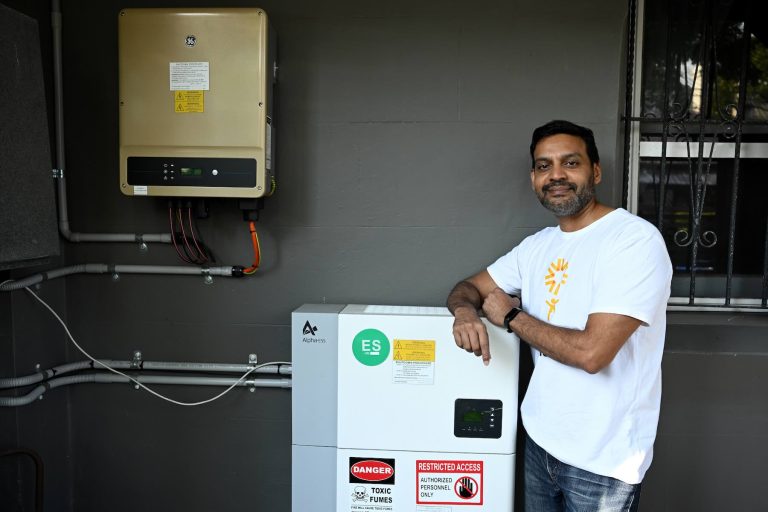
Eldridge noted that by 13:50 AEST, the NEM had curtailed approximately 54.8 GWh of renewable energy, while flexible loads consumed around 22.5 GWh, including 17.3 GWh directed to batteries and 5.2 GWh to pumped hydro storage. He acknowledged the significant capacity for absorption from home batteries installed behind-the-meter.
“During the initial period where renewables surpassed 80% of NEM consumption, the system was not only:
- sourcing over four-fifths of demand from renewables and storage
- lowering coal’s contribution to less than one-fifth
- absorbing upwards of 5.3 GW of flexible load
- charging batteries at a rate of approximately 4.5 GW
- curtailing an additional 8.4 GW of potential renewable energy output
This combination represents an increasingly integral aspect of the NEM’s shift towards a more sustainable future.
The narrative is evolving from simply increasing renewable sources to a broader perspective: higher shares of renewables lead to lesser shares of thermal generation, alongside expanded flexible loads, battery storage utilising surplus energy, and significant renewable output curtailment.
On this day, for the first time, this progressive transition allowed renewable supply to exceed 80% of NEM consumption.