Jinko Solar Launches High-Efficiency All-Black Rooftop Panel
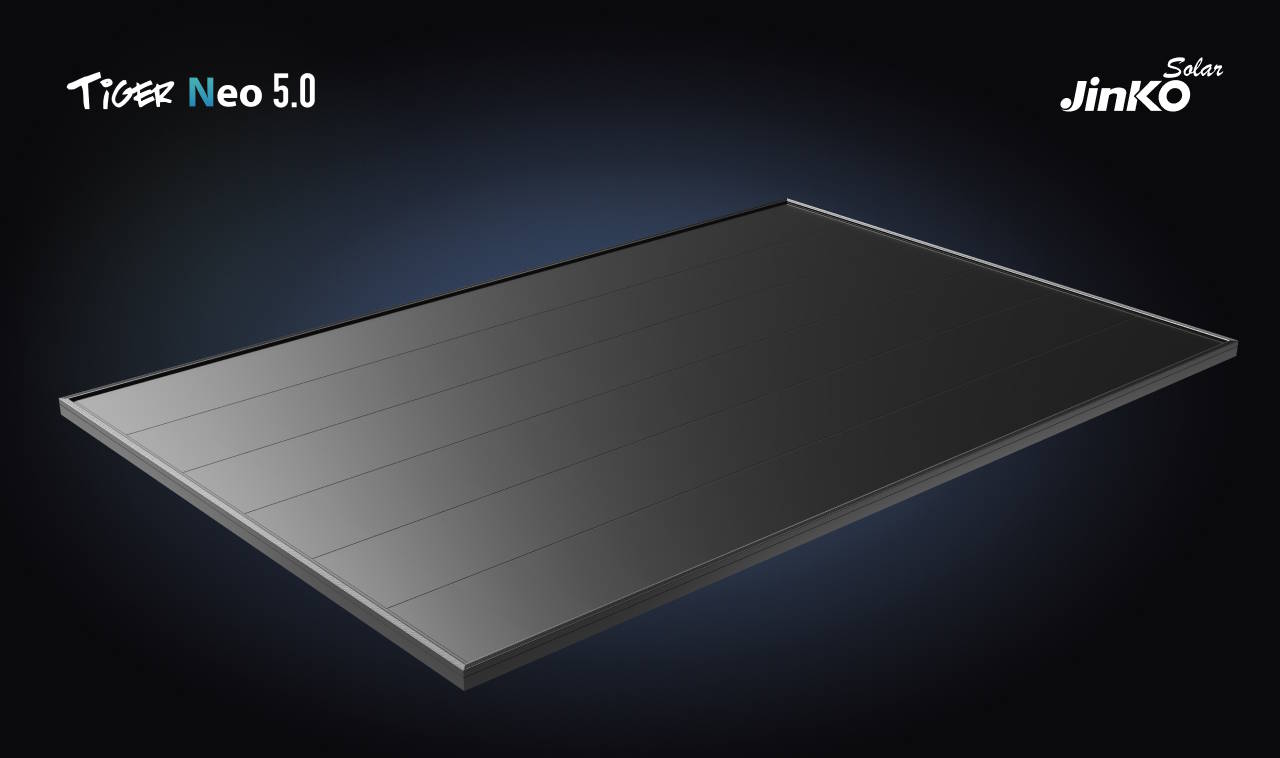
Chinese solar manufacturing powerhouse, Jinko Solar, has announced its latest innovation: a 510 watt (W) all-black rooftop solar panel that boasts a remarkable module efficiency of 25.52 per cent. This new offering, named the Tiger Neo 5.0, aims to set new standards in both aesthetic appeal and efficiency for solar technology.
Marketed as a product designed to push the boundaries of what a specialised module can offer, the Tiger Neo 5.0 is aimed at premium residences and architecturally sophisticated homes, according to the company. This model represents Jinko Solar’s first utilisation of its new TAC technology, which stands for TOPCon-based Amorphous-Si Passivating Cell. The “2+1” design uniquely combines TOPCon electron-selective contacts with HJT hole-selective contacts, configured in a rear-electrode layout.
Innovative Design and Efficiency
The innovative design seeks to eliminate the front-side metallisation that often leads to optical shading losses, achieving a peak efficiency of approximately 28 per cent, which is close to the theoretical maximum for monocrystalline silicon cells. Although Jinko Solar revealed this cutting-edge TAC technology at its recent Global Tech Day, the focus with the Tiger Neo 5.0 is largely on its visual appeal.
As per Jinko Solar, the new solar panel presents a more uniform and refined black finish compared to typical back-contact (BC) modules. This sophisticated black aesthetic is said to allow the panel to integrate seamlessly with darker residential rooftops.
Refined Performance for Modern Homes
Charlie Cao, CEO of Jinko Solar, expressed, “Our vision for Tiger Neo 5.0 was to develop a panel tailored to premium residential rooftops.” He further noted how the new panel enhances both performance and aesthetics through advancements in cell technology, passivation processes, structural design, module format, and interconnections. With this launch, Jinko Solar aims to steer the industry towards more application-specific solutions.
The Tiger Neo 5.0 is also equipped with semiconductor-grade processes designed for both low and high temperatures, which helps achieve a power temperature coefficient of -0.24%/℃. This capability promotes enhanced energy yields even in warmer climates.
In addition, the panel features a zero-gap cell layout and hidden-ribbon technology, contributing to the advertised 25.52 per cent efficiency. When compared to traditional back-contact products, the Tiger Neo panel offers approximately 30 W more power along with its lower temperature coefficient.