Innovative Solar Farms for Cattle: Is Australia Prepared for Change?
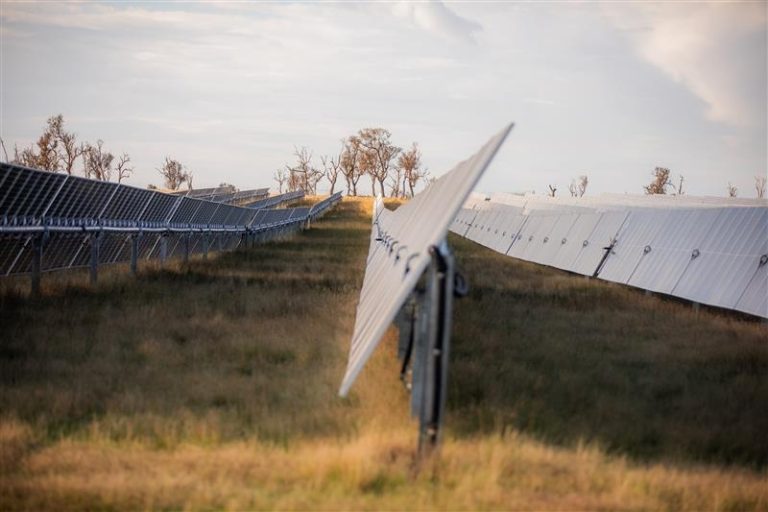
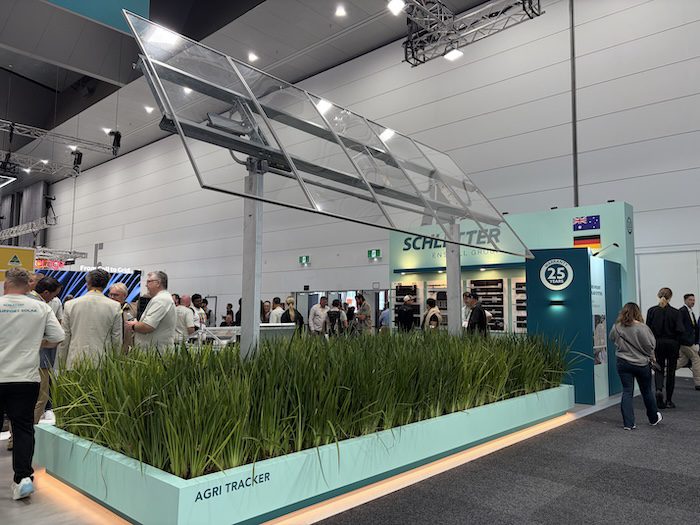
Amid the bustling atmosphere of the All Energy Australia conference in Melbourne, a serene scene unfolds with lush green grasses lying undisturbed beneath a massive steel solar tracker. This picturesque setting serves as an oasis within the busy exhibition centre.
One might almost envision cattle peacefully grazing below, and this imagery aligns with the intentions of Schletter, a German company that showcased its solar mount system, designed to be friendly to both livestock and horticulture, for the Australian market.
First Steps Towards Cattle-Friendly Solar
As one of only two companies exploring the potential for cattle-compatible solar setups, Schletter is marking a significant step forward in a trend that has been largely stagnant since a trial at Farrer Memorial Agricultural High in Tamworth in 2020, along with some earlier installations by Queensland farmer Caitlin McConnel.
Thomas Dorsch, Schletter’s sales manager, explained that the system’s lowest point is approximately 2.1 metres high, providing sufficient clearance for cows to move freely underneath. This system has already been implemented in Europe, where mounting concerns over the use of agricultural land for solar energy have prompted developers to prioritise the integration of farming practices alongside energy production.
Challenges of Integrating Cattle and Solar Farms
While Australian farmers have adapted to the concept of grazing sheep beneath solar installations, the integration of cattle presents additional challenges, both mentally and logistically. Cattle generally do not climb on solar infrastructure and are unlikely to chew through wires, but their propensity for scratching could pose risks to solar panels due to their weight.
Karin Stark, director of Farm Renewables Consulting, highlighted the increasing demand for renewable energy solutions that coexist with farming. This includes adjusting the height of solar panels to facilitate agricultural use beneath them, although such modifications remain uncommon in Australia.
One farmer from Casino in New South Wales had discussions with a solar developer about a potential project but insisted on raising the solar arrays by an additional 300 millimetres to accommodate his cattle. Unfortunately, this request proved too challenging for the developer to integrate.
Insurance Concerns and Weather Risks
The necessity for raising solar panel heights may also be influenced by insurance considerations. Tokio Marine GX has issued warnings about the anticipated complex losses following the incoming El Niño cycle, estimating global weather-related losses for renewable energy to have already reached $300 million this year, with extensive damage coming from floods and hail impacting solar farms.
Rosie Oldfield, co-founder of the Australian startup Storm Safe Solutions, claims their technology can effectively withstand both cyclones and livestock. They are currently running trials that may provide solutions for those looking to mix livestock with solar installations. Oldfield noted that their systems have attracted significant interest, with around 300 megawatts of potential demand being explored.
Finding Balance in Agricultural Land Usage
The vital question moving forward is whether Australia will address the pressures surrounding the preservation of productive agricultural land in a manner similar to Europe, which may drive the adoption of taller, costlier solar systems.
While neither Schletter nor Oldfield disclosed exact cost comparisons between their taller systems and standard ones from larger global firms, they did agree that increasing the height does not considerably escalate material costs, such as steel or concrete for footings. Nonetheless, calculating costs remains challenging as the systems have only recently been introduced into the Australian market.
Oldfield is also exploring funding opportunities with the Australian Renewable Energy Agency (ARENA) for a trial in New South Wales, which would involve testing their prototype on a participating farm.
As he elaborated, optimising solar yield remains a primary focus, but there is significant potential in selecting the best agricultural land that benefits from enhanced uses. This represents a shift in approach, emphasising the maximisation of agricultural purposes before solar energy generation.
The Future of Solar and Agriculture
A critical aspect yet to be resolved is the need for more concrete examples of taller mounting systems and their effectiveness in allowing cattle grazing beneath. With Schletter introducing its solutions recently and Storm Safe Solutions still in the early phases of its development, the landscape of this dual-use sector is evolving.
In the meantime, vineyards are showing keen interest in solar technology that provides shade while protecting their crops from harsh sunlight. Oldfield mentioned that they are collaborating with a company developing solar panels designed to permit red spectrum light to pass through, though details are confidential. Additionally, Charles Sturt University is devising panel designs that leave gaps between photovoltaic cells to facilitate sunlight reaching plants below, with preliminary trials in Europe showing these panels allow between 10 per cent and 48 per cent of light through.