Australia’s Renewable Projects to Provide Data Centres Power Below $66/MWh
The developer behind Australia’s largest renewable energy initiatives has revealed plans to offer extremely low-priced electricity deals to data centres at under $US50 per megawatt-hour (MWh) – less than half the rate of current competitors and significantly lower than gas prices.
InterContinental Energy is spearheading two colossal wind and solar ventures: the 26 gigawatt (GW) Australian Renewable Energy Hub located in Western Australia’s Pilbara region, and the even larger 70 GW Western Green Energy Hub in the south-east of the state. The success of these developments is closely tied to its green hydrogen projects aimed at producing green iron and ammonia, yet CEO Alex Tancock also sees a promising opportunity in supplying renewable energy to data centres with substantial capacity.
Cost-Effective Energy Solutions
During a recent interview with Renew Economy, Tancock noted that they aim for costs below $US48 per MWh (approximately $A66/MWh) for a tier four data centre. This price point is significantly lower than that offered by conventional firmed renewable energy sources and is just a quarter of what data centres pay for gas-powered electricity in locations such as Singapore.
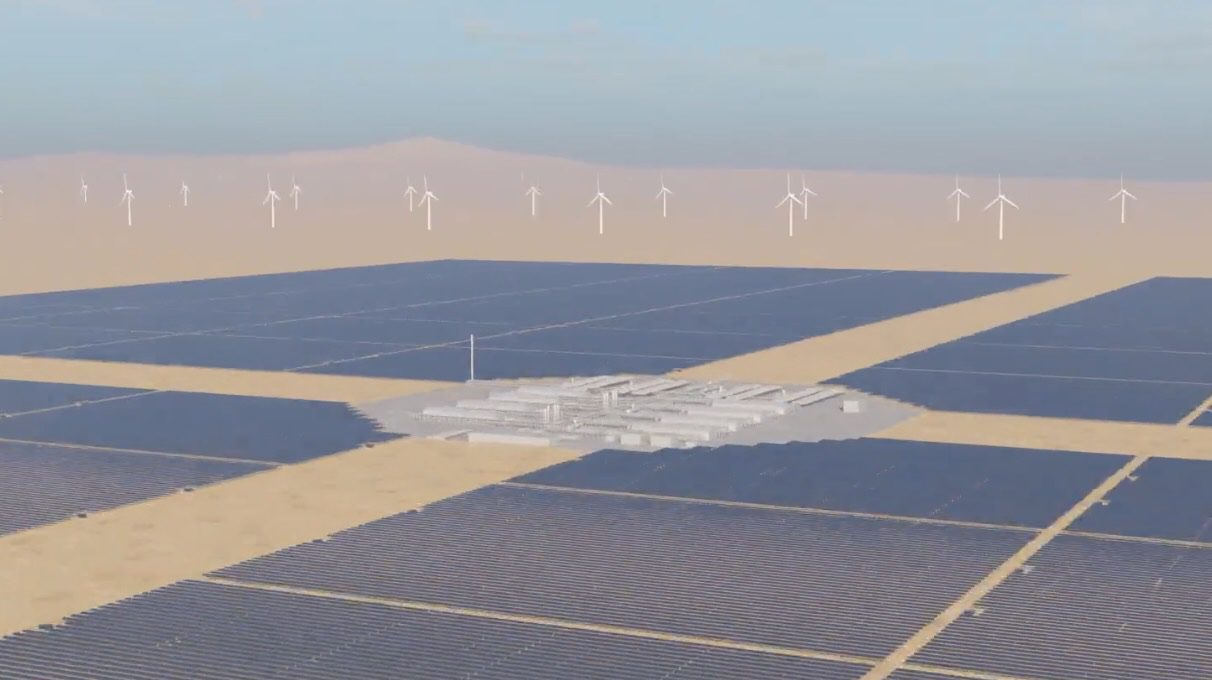
InterContinental’s strategy involves creating two gigawatt nodes, likened to Lego blocks that integrate around 1 GW of wind energy and 1 GW of solar energy. These nodes will supply power directly to data centres while also serving the hydrogen electrolysers that produce the key materials for their primary clients.
Innovative Hydrogen Storage and Efficiency
The Pilbara region boasts robust wind and solar resources; however, the low costs for data centres primarily come from bypassing hefty system costs, high voltage transmission, and the need for battery storage. The concept revolves around utilising hydrogen production, which is inherently linked to their operations, to mitigate the impacts of variable energy output.
“Our hydrogen production isn’t geared towards energy storage but rather to fulfil the needs of our main customers focusing on green iron or ammonia,” Tancock explained. “This enables us to utilise some of that hydrogen to provide a top-up during periods of low renewable energy production, like windless nights, which are infrequent.” This mechanism effectively creates an economical form of energy storage.
Integrating Data Centres with Renewable Resources
Another crucial aspect of their strategy is the construction of data centres within the expansive wind and solar farms, thus eliminating the necessity for extensive transmission systems. Power will be transferred using 66 kW lines from the wind turbines to the hydrogen production facilities.
Moreover, this configuration allows data centres to benefit from the inherent cooling systems of the nodes. Given that cooling can account for a significant portion—up to one third—of energy consumption in data centres, this is a significant advantage.
Tancock mentioned that the patented P2(H2)Node, developed by his team in Perth, is designed to cater to data centres requiring around 200 MW of demand per node. Interestingly, this aligns with similar offerings from Andrew Forrest’s Fortescue, which is constructing a vast green grid to ensure its iron ore mines achieve “real zero” emissions by 2030.
Pioneering Growth and Pricing Strategy
Incorporating data centre components carefully into each node is essential, according to Tancock. However, InterContinental is exploring the possibility of 47 such nodes throughout the AREH and WGEH projects over the upcoming 20 years, which would vastly enhance data centre capacity while securing competitive energy prices.
Tancock outlined the potential for up to 2.4 GW of data centre capacity within their Pilbara plans, escalating to 12.5 GW if both projects reach their target capacities. “With each additional Lego block, energy storage is effectively augmented at no extra cost, as the connecting pipelines function as energy storage,” he remarked.
“The initial Lego block poses the biggest challenge, but constructing the first one sets the stage for subsequent developments, which become progressively easier,” Tancock stated. He drew parallels with the evolution of Australia’s LNG and iron ore resources, noting that while launching the first projects can be complex, scaling up becomes much more straightforward.
The Path Ahead
InterContinental Energy is backed by substantial investors, including the Singaporean GIC, yet Tancock highlighted that government support will be crucial for the first project, mirroring the historical necessities of other industries.
However, the Western Green Energy Hub faces challenges, including complicated environmental approvals and opposition from groups like the Bob Brown Foundation, who are concerned about the ecological ramifications.
Tancock remarked that discussions around Australia’s potential as a renewable powerhouse have typically focused on either electrons (via cables) or molecules (through e-fuels and hydrogen). “There’s a third avenue now, which encompasses the provision of data as a computational service to billions of customers across Asia,” he added.
Early discussions with suppliers and data centre companies have been promising, with many recognising the potential embedded within this innovative model.