Australia’s First Biosolar Roof Enhances Power Generation and Biodiversity
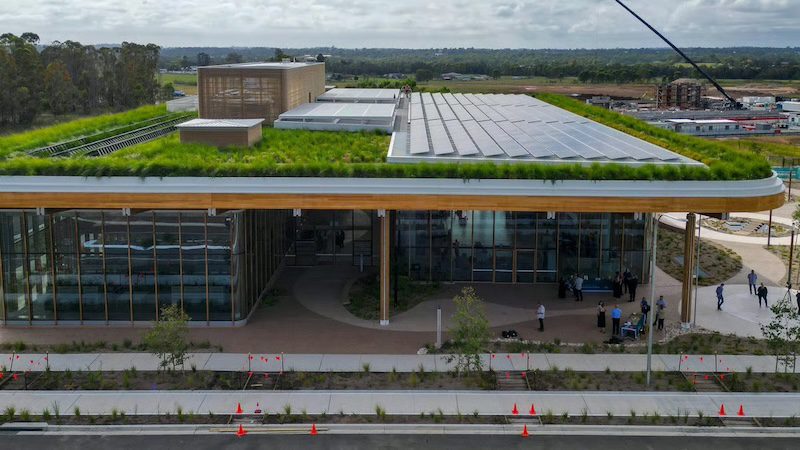
In the newly established suburb of Bradfield, Western Sydney, a remarkable structure has emerged, featuring a unique biosolar roof. Spanning 1,300 square metres, this roof is home to a lush native garden as well as 180 kilowatts of solar panels, making it a pioneering example of sustainable architecture.
This biosolar initiative forms part of a project led by the University of Technology Sydney (UTS), which explores the advantages of cultivating plants beneath solar panels, aiming to enhance energy efficiency and promote biodiversity while also considering the well-established benefits of green roofs within urban environments.
Impressive Results from the Summer Assessment
UTS researchers have recently evaluated the project’s performance during the intense summer of 2025, yielding remarkable findings. The Bradfield project comprises two distinctive configurations: a larger standard solar panel setup without a plant bed and a smaller area where panels are integrated with lush vegetation.
During particularly sweltering days, typical of Western Sydney’s notorious heat island effect, the green roof maintained temperatures as much as 28ºC cooler than its metal counterpart. With solar panels operating best at around 25ºC, the notable reduction in temperature resulted in up to a 23.25 percent increase in energy production.
Over the four-month observation period, the integrated panels outperformed traditional installations by an average of 11.1 percent, equating to an additional 0.24 kilowatt-hours (kWh) per panel each day. In addition, the biosolar roof has fostered an ecosystem that supports 39 species of birds, including kookaburras, a variety of insects, and essential pollinators. It also efficiently retains approximately 75 percent of the stormwater that falls on it, while a plant-based filtration system effectively removes nearly all heavy metals from that runoff.
The Future of Biosolar Installations
The Bradfield Development Authority mandates that 80 percent of applicable roof space on new constructions incorporates either green or biosolar roofs. Given that this is a newly developed area situated near the future Sydney airport, there is significant potential for innovative urban planning approaches.
The pressing question remains: can the biosolar vision be replicated elsewhere, particularly on existing buildings? Irga is hopeful about integrating this concept into upcoming building standards.
“Currently, we are advocating for revisions in the National Construction Code to promote green roofs alongside solar panel installations,” notes Irga, expecting possible implementation progress by March or May 2027.
While national guidelines do not explicitly prevent the establishment of biosolar systems, the Clean Energy Regulator states that rooftop installations must adhere to Australian standards to qualify for small-scale certificates under the renewable energy scheme.
Cost-Effectiveness of Biosolar Solutions
Research has already suggested that biosolar roofs are economically advantageous for commercial and industrial buildings. In 2020, the UTS team assessed the rooftops of two adjacent buildings in Barangaroo, finding that while both had solar panels, only one featured a green roof.
The findings indicated a significant energy yield from both rooftops during the monitoring period: 69 megawatt-hours (MWh) for the green roof, compared to 59.5 MWh for its conventional twin. After normalising for various factors, the green roof generated an additional 9.5 MWh over an eight-month span, translating to a retail market value of $2,595 based on a power price of $270/MWh.
Irga perceives the Barangaroo comparison as a pivotal moment that propelled the commercial installation at Bradfield, leading to increased funding aimed at experimenting with food cultivation beneath solar panels, commonly referred to as agrivoltaics.
While it may not resemble a traditional farm, this initiative could involve raising small animals or growing low-lying crops like herbs or strawberries. “With sufficient rooftop space and integrated solar panels, we might consider agricultural applications,” explains Irga.
Global Trends in Green Urban Spaces
As densely populated areas such as Europe, Korea, and Singapore grapple with spatial constraints, the integration of energy and food production is gaining traction. Concepts of creating closed-loop economies within building environments are increasingly being explored, such as composting waste on rooftops and cultivating edible crops alongside solar energy generation.
Internationally, cities like Basel, Switzerland, have championed the sustainability discourse since the 1990s, introducing mandates for green roofs in new constructions in 2002. Furthermore, Hamburg has mandated biosolar systems for all new buildings with roof pitches below 10º, requiring a minimum of 30 percent of the roof space to allocate for solar panels.
Across Europe, from Norway to Austria, similar initiatives are being implemented to merge energy production with urban agriculture, demonstrating a growing commitment to sustainable living.