Western Australia Surpasses National Grid in Renewable Energy Transition
In a surprising turn of events, Western Australia (W.A.) is now at the forefront of the nation’s shift towards renewable energy, surpassing all other states. The South West Interconnected System (SWIS), W.A.’s main grid, has outperformed the National Electricity Market (NEM) over the past three months, boasting a renewable energy share of 50.7%, compared to the NEM’s 49.9%.
December proved particularly noteworthy for the region, with W.A.’s grid hitting 53.9% renewable energy share, outdoing the NEM’s 50.4%. Both figures are unprecedented monthly highs.
A Unique Challenge
Remarkably, W.A.’s achievements in renewable energy are all the more impressive given its isolated grid configuration, which lacks transmission connections to other states or countries for energy exchange. Furthermore, W.A. has no pumped hydro storage, relying solely on wind and solar power for its renewable output, with battery storage—both at the household and grid scale—serving as its only means of energy storage.
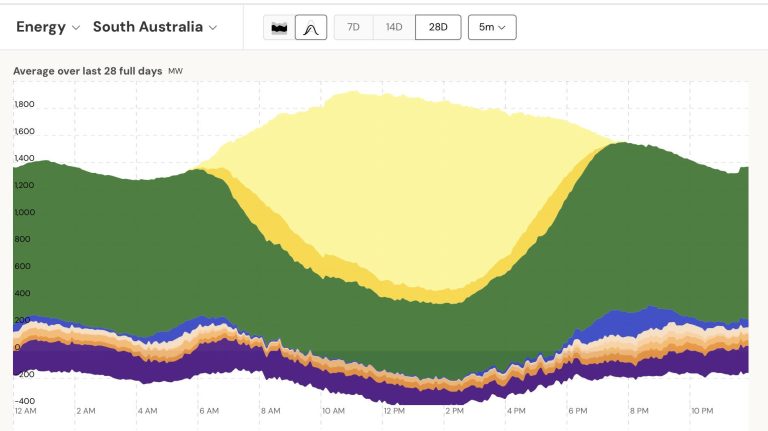
Not too long ago, W.A. faced issues related to the solar “duck curve,” a phenomenon caused by widespread adoption of rooftop solar in Perth and surrounding regional areas. Due to its grid’s limitations, W.A. cannot allow rooftop solar production to fully meet local demand, unlike South Australia, which managed to reach this milestone over two consecutive days during Christmas. This limitation further emphasises the challenge W.A. faces in balancing its renewable energy supply.
Investments in Battery Storage
To address these challenges, Western Australia has rapidly expanded its battery storage capabilities. This includes the development of the two largest batteries in the country, located in Collie, a hub for coal production. Each of these facilities boasts more than 2 gigawatt hours of storage capacity, significantly contributing to the stability and efficiency of the grid.
Jai Thomas, the co-ordinator of Energy Policy W.A., likened the state’s energy transition over the past decade to a crocodile’s head, with renewable sources now overtaking coal and gas. He anticipates that the remaining coal-fired plants will close by the end of the decade. Thomas expressed optimism about the future, stating that ongoing investments in transmission and renewable developments promise further advances in the energy transition.
Top Performers in Renewable Energy
These large-scale batteries have been instrumental in minimising curtailment while propelling W.A.’s wind and solar farms to top rankings across the nation. Rystad Energy analyst David Dixon reported that the three highest-performing wind farms in Australia last December were all located in W.A., with the Badgingarra wind farm leading at an impressive average capacity factor of 60%. Following closely were Yandin at 59.9% and Warradarge at 56.4%. Additionally, two other W.A. wind farms, Collgar and Emu Downs, secured fourth and fifth place, respectively.
W.A. also claimed the title for the best-performing solar farm in December, with the Merredin facility achieving a capacity factor of 45.2%. In comparison, two solar facilities in New South Wales, Griffith and Moree, reported capacity factors of 40.1% and 39.7%, respectively.
Interestingly, New South Wales set a new record by generating over 1 terawatt hour (TWh) from utility-scale solar in December. The state contributed 1.05 TWh from solar and an additional 626 gigawatt hours (GWh) from wind energy, while the total renewable generation across the NEM reached 9.5 TWh for the month. Open Electricity reported that curtailment levels for December stood at 6.3%.
Notable Trends in Energy Generation
Dixon’s analysis indicates that December marked a historic low for coal generation across the NEM, the eighth lowest since 2011, and highlighted the fourth-lowest gas generation month. This downward trend is expected to persist as household and large-scale batteries continue to proliferate.
In the past year, the capacity of grid-scale batteries surged more than threefold across both the NEM and the SWIS, with NEM batteries discharging 248 GWh in December 2025, a significant jump from 68 GWh in 2024. In W.A., batteries discharged 102 GWh last December, up from just 32 GWh the previous year.
December also recorded unprecedented levels of negative pricing in nearly all NEM states, except Tasmania. In South Australia alone, negative prices occurred for 351 hours, representing 47% of the month, while Victoria recorded 290 hours, Queensland had 189 hours, and New South Wales noted 159 hours of negative prices.