Transforming My Home into a Small Power Station
There are certain moments in adult life that signal a shift in perspective, such as having earnest debates about interest rates or forming strong opinions on insulation materials. Recently, I’ve found myself excitedly observing the installation of what appears to be an entire data centre’s worth of equipment outside my house at 8am.
This isn’t an isolated incident. Across Australia, a growing number of homes—now numbering in the hundreds of thousands—are outfitted with solar and battery systems. The adoption rate has seen a significant spike, particularly following the introduction of the federal battery rebate in 2025. Approximately 200,000 households have taken advantage of this rebate to add energy storage, with many more considering similar upgrades.
Empowering Households with Energy Independence
Homes are evolving into mini power generators, capable of producing, storing, and, when necessary, supplying energy back to the general grid. This evolution isn’t solely about saving money; it signifies a broader change in how consumers interact with the electricity grid. Energy, which previously flowed in one direction, can now be pushed back upstream during the day, allowing households like mine to draw power only when truly needed.
A couple of months back, Sungrow and Aiko approached me to document the installation of my solar and battery setup. Sungrow supplied a 25kWh battery, a 10kW hybrid inverter, and an EV charger, while AIKO contributed 21 of their Neostar 475W solar panels. I opted for an additional seven panels, bringing the total capacity to 13.3kW.
Tracking the Installation Journey
This article centres on the installation process itself. In the following weeks and months, I’ll be gathering data and sharing my experiences of living with this solar and battery setup in a typical Sydney home.
The surge in home battery installations is about more than just placing solar panels atop roofs or admiring cutting-edge display screens. It represents a meaningful shift in energy behaviour and consumer expectations.
Ten years ago, solar energy was mainly about lessening reliance on the grid during daylight. Batteries were scarcely adopted, and electric vehicles (EVs) were still a novelty. Nowadays, all three elements have converged. Many Australian homes that choose to install solar and batteries also add EV chargers, creating a trifecta that enhances self-sufficiency.
The Technology of Energy Storage and Usage
Generating energy during the day is one accomplishment; storing it for nighttime use and powering an EV is another leap altogether. This transition in electrification has consequences for both households and the broader electricity grid.
Policymakers have taken notice of these developments, leading to efforts to create tariffs, rebate schemes, and incentives that align with this evolving reality, as opposed to outdated frameworks where consumers passively drew power from the grid.
The environmental advantages of this movement are clear, but there’s also an essential economic and behavioural aspect. Homes equipped with energy storage and EV charging can actively engage with the energy system in ways never previously imagined.
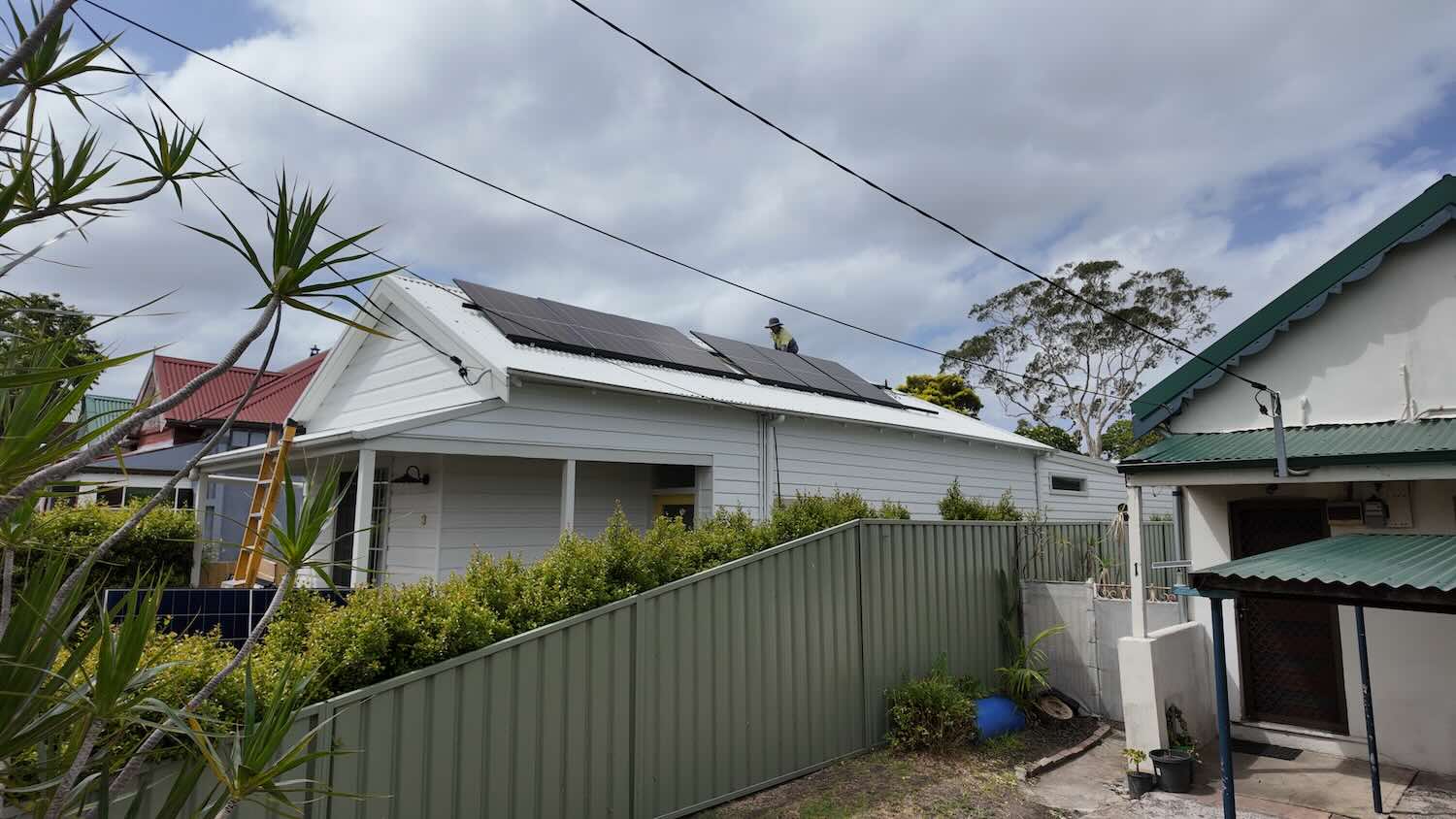
The initial component installed on the roof isn’t the solar panels themselves; it’s the racking system. Aluminium rails are affixed to the roof structure, forming the foundation for everything else to attach to. While it may lack glamour, this step is arguably the most crucial part of the entire setup. Once installed, the panels aren’t merely resting on the roof; they’re integrated into the very structure of the house.
Following this, solar panels are carefully positioned, aligned, and secured in place. These are not hurried installations; the 28 AIKO Neostar units are equipped with modern cell technology intended to capture every potential photon from the sun.
Installation Insights and Future Prospects
These solar panels not only look appealing on my roof but will also play a vital role in keeping the lights on for years to come. Observing the expert installers handle the equipment underscores the importance of hiring a qualified professional for such a critical project.
The Sungrow SBH250 battery system is modular, made up of stacked 5kWh modules to achieve a total of 25kWh—plenty for household needs. This larger capacity reflects a broader trend; just two or three years ago, typical residential battery installations were much smaller, but today they are trending towards higher capacities as prices decline and homeowners recognise the benefits of energy storage and improved feed-in tariffs (FiT).
The installation proceeds with the addition of a 10kW Sungrow hybrid inverter, robust cabling, safety sheets, communication units, and the Sungrow AC-22 EV charger. There’s an impressive level of precision involved, reminiscent of a well-crafted appliance rather than a futuristic gadget.
However, it’s important to highlight that not all homes are equally fitted for this transition. Factors such as roof orientation, shading, local network constraints, and the structure of electricity tariffs influence whether a solar, battery, and EV system is financially sound. While some households can see immediate benefits, others may find the payback period lengthy. Yet many derive a significant intangible benefit from energy independence, providing a sense of control over their energy future amid rising prices and market uncertainty.
Within less than two days of installation, I’ve come to realise my home is now part of the distributed energy system. It operates silently, efficiently managing energy flow from the sun to battery, appliances, and car, all directed by software accessible from my phone. I’ve transitioned from just being a consumer to a ‘prosumer,’ capable of generating, storing, scheduling, and exporting energy—a seismic shift from a century-old passive relationship. Electricity has transformed from a simple utility into a resource that can be managed and optimised.
With the installation wrapped up, I’ve started monitoring energy generation and consumption, adjusting behaviour, and assessing real-world performance. I’ll provide updates soon to evaluate whether the return on investment—for many households, a significant financial commitment even with current rebates—is worthwhile. Feel free to leave comments on any particular topics you’d like me to explore further in my future updates.
This piece is part of a three-part series that documents the process of installing and living with residential solar and battery storage, sponsored by Sungrow and AIKO.
Installed equipment:
- Sungrow 25kWh SBH250 Battery
- AIKO Neostar 2P+ 475W Solar Panels (Total: 13.3kW)
- Sungrow 10kW SH10RS Hybrid Inverter
- Sungrow AC22E-01 EV Charger