Renewables Supply Half of Grid, Prices Plunge as Coal Hits Record Low
The Australian Energy Market Operator (AEMO) has celebrated the December quarter as a pivotal moment, reporting a dramatic decline in wholesale electricity prices alongside significant achievements in renewable energy production. For the first time, renewables supplied half of the country’s electricity demand, with battery output also experiencing a substantial surge and coal generation reaching record lows.
AEMO indicated that average wholesale electricity prices within the National Electricity Market (NEM) fell nearly 50% during the December 2025 quarter compared to the previous year, dropping to just $50 per megawatt hour (MWh). This reduction is attributed to an unprecedented increase in renewable energy and storage capacity.
Record Output and Emission Reductions
The report highlighted that battery discharge levels have tripled, wind energy output rose by 29%, and rooftop solar reached new heights. Simultaneously, coal generation fell by 4.7%, marking a new quarterly low, while gas production sank by 27%, hitting the lowest point in 25 years.
Carbon emissions also fell to a record low of 23.4 million tonnes of CO₂-e, representing a 6.2% decrease from the previous year, with emissions intensity dropping by 7% to an unprecedented low of 0.53 tCO₂-e/MWh. This quarter proves a significant point made by government and market representatives over recent years: increased use of renewables and storage leads to lower prices and emissions whilst maintaining a reliable electricity supply.
A Bright Future for Renewables, but Challenges Ahead
“This is a landmark moment for the NEM,” stated Violette Mouchaileh, AEMO’s head of policy and corporate affairs. “It reflects years of sustained investment and shows that the increased capacity of wind, solar, and batteries lessens reliance on the more expensive coal and gas generation, thereby exerting downward pressure on wholesale electricity prices.”
However, forecasts for the March quarter might paint a less optimistic picture due to extreme heatwaves that impacted the nation in January. The significant price spikes observed on January 26 in South Australia might skew the figures, even though increased demand was adequately met.
The Government’s Renewable Aspirations
With an objective of achieving 82% renewables by 2030, federal energy minister Chris Bowen remains optimistic despite concerns surrounding the feasibility of this target. He emphasised the achievements of the December quarter, which also saw the end of a prolonged investment hiatus. “Australia benefits from exceptional wind and sunlight for our energy future, and this strategy is proving effective,” Bowen stated.
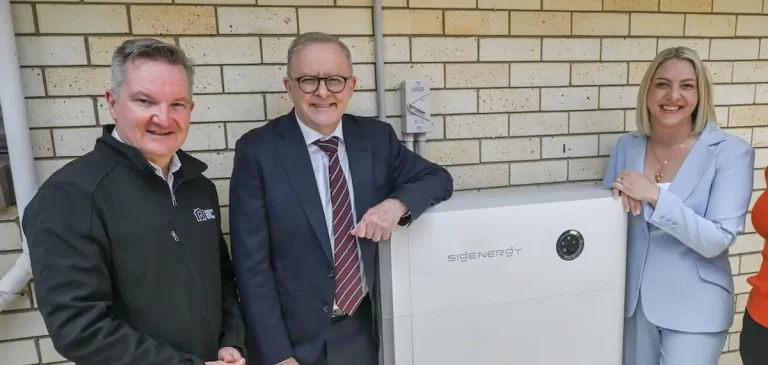
Record-high energy demand towards the end of last year coincided with substantial investments in battery technology, including the affordable home battery rebate programme, facilitating greater utilisation of solar energy and thereby protecting consumers from the volatility associated with coal while lowering overall wholesale energy costs.
Wholesale Prices Across the States
It’s noteworthy that average wholesale prices were at their lowest in states with the highest percentages of wind and solar, like Victoria and South Australia, which recorded prices of $37/MWh. Conversely, states heavily reliant on coal, such as New South Wales and Queensland, faced much higher prices of $75/MWh and $58/MWh respectively, though all states saw reductions compared to the previous year.
Bowen commented on the promising decline in wholesale prices: “This is positive news, and we are working to ensure that these savings are reflected in retail prices.” The December Quarterly Energy Dynamics report underlines a rapidly evolving energy landscape, where traditional power sources such as hydro, brown coal, black coal, and gas are increasingly being overshadowed by the growing output from wind, solar, and battery storage.
Renewable Energy Peaks and Future Considerations
Examining the dynamics of renewable energy share, the NEM reached a new instantaneous peak of 78.6%, while a potential peak reached an impressive 113.9% in the same quarter. The disparity arises from AEMO’s requirement to maintain sufficient synchronous generation to ensure grid security, a necessity that will persist until transmission companies can deploy enough synchronous condensers or gain approval for battery grid-forming inverters to provide the needed grid “system strength.”
Challenges of curtailing wind and solar energy due to network restrictions and negative pricing have also been observed, as there is insufficient storage capacity to accommodate the excess renewable output.
State-Specific Achievements
There have been remarkable state-level achievements, notably in South Australia, which achieved a peak renewable generation of 98.7%, solely from wind and solar. New South Wales followed with 86%, Victoria with 82.5%, and Queensland, the most coal-dependent state, with 70.6%.
In an interesting development, Western Australia, the largest isolated grid globally, recorded wind and solar penetration reaching a peak of 91%, highlighting the regional variations in energy production as discussed in concurrent reports.
Renewables’ contributions during peak demand periods have sparked lively discussions, with the average share of renewables (middle line) juxtaposed against peak and minimum shares during maximum grid demand. Notably, this data does not incorporate the effects of rooftop solar, which has recently demonstrated a significant ability to alleviate grid demand, particularly amid recent heatwaves.