New Low-Cost Solar Cells Replace Indium with Abundant Tin Oxide
A collaborative effort by an international team of researchers has led to the development of the first high-performance, commercially viable tandem solar cell that eliminates the need for indium, a rare and costly metal, instead using a much more plentiful material that costs just one per cent of indium’s price.
The clean energy sector faces significant hurdles due to its dependence on rare earth elements, which, as the name suggests, are limited in availability, thus making them expensive and often sourced from ethically questionable mining practices.
Challenges with Indium and Innovations in Solar Technology
This dilemma is particularly relevant for indium, which is obtained solely as a byproduct of processing base metal ores like zinc sulphide. The rarity of indium significantly complicates large-scale manufacturing despite its widespread application in various electronic devices.
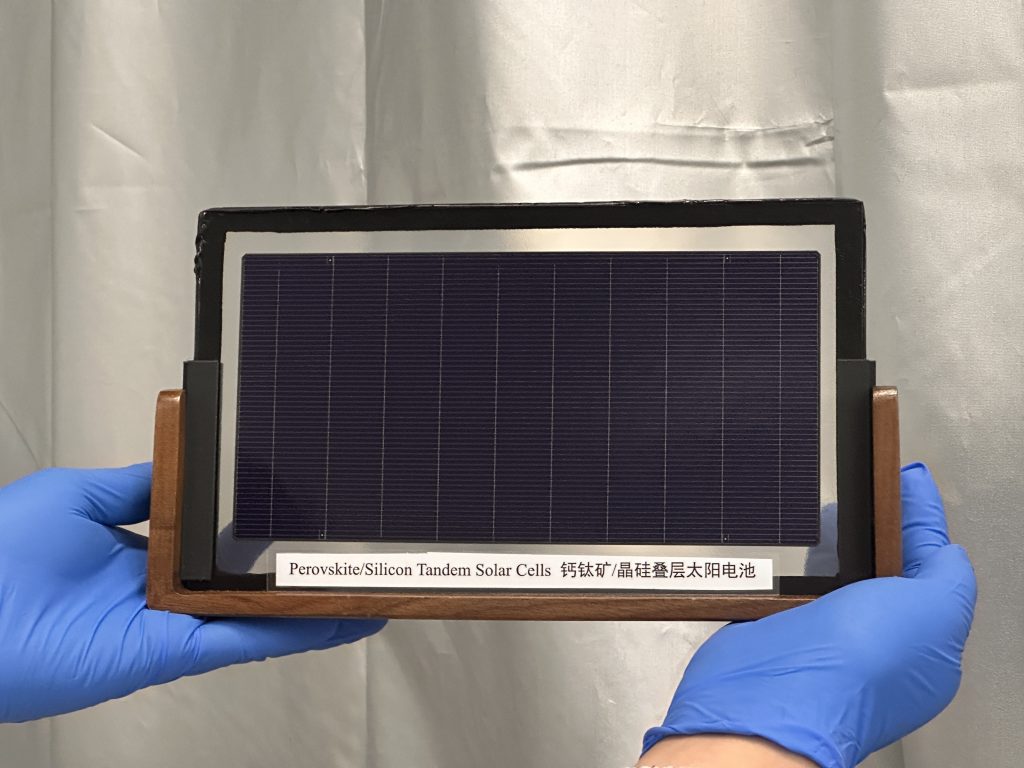
In an attempt to address these issues, a coalition of researchers from China, Australia, and the UK has engineered a high-performance, commercially sized tandem solar cell that substitutes indium-based oxide with tin oxide without compromising efficiency.
This groundbreaking achievement, detailed in the journal Science, may bring next-generation tandem solar cells closer to commercial application, potentially allowing for more affordable solar panels that produce increased power from the same quantum of sunlight.
Significance of the Research
Professor Yuan Cheng from Monash Suzhou and Monash University’s Department of Materials Science and Engineering highlighted that this achievement represents the first large-area, high-efficiency indium-free perovskite tandem solar cell. It demonstrates that this technology can be expanded beyond mere laboratory prototypes.
“With tin costing only one per cent of the price of indium, this innovation introduces an exciting new material dimension and a practical engineering strategy for economical, sustainable, and scalable tandem photovoltaics,” Professor Cheng commented.
He added, “This development holds significant strategic value for advancing the industrialisation and deployment of ultra-high-efficiency photovoltaic technologies at a terawatt scale.”
Collaborative Research and Development
The project involved over 30 researchers from various institutions and companies, including Monash Suzhou, the College of Energy, the Institute of Functional Nano and Soft Materials (FUNSOM), and the Department of Materials at the University of Oxford, as well as the Department of Materials Science and Engineering at Monash University, Clayton.
The team successfully substituted indium with tin oxide through what they term a “low-damage reactive plasma deposition process,” resulting in the creation of commercially sized solar cells that achieved a certified efficiency of 31 per cent.
The developed solar cells have demonstrated resilience against heat, humidity, and more than three months of outdoor use while continuing to perform strongly.
A Major Milestone in Efficiency
Professor Cheng also pointed out that reaching over 30 per cent efficiency in a commercially sized tandem module is a considerable technical milestone, proving that high performance can be maintained without relying on rare and costly materials.
“By extending the RPD-SnOx application to utilise both the front and rear transparent electrodes, we successfully produced indium-free tandem solar cells and astonishingly scaled the technology up to a 207.9 cm2 mini-module, attaining an incredible certified efficiency of 31.0 per cent.”