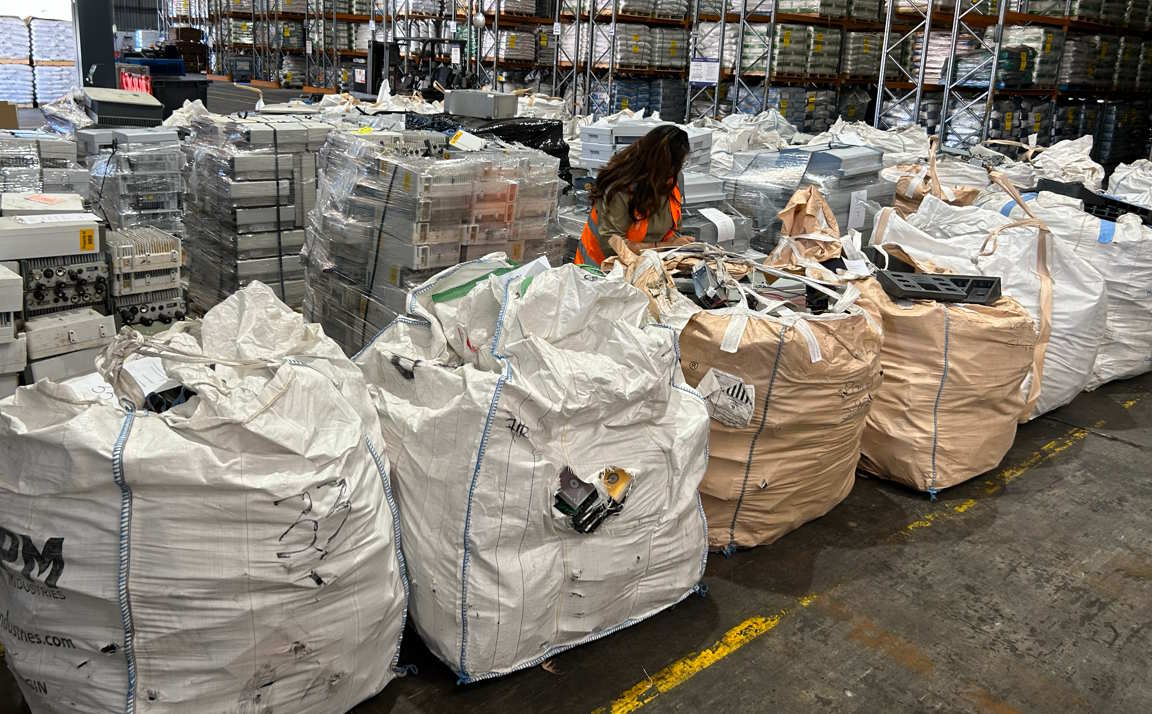
Illegal Solar Panel Exports Threaten Australia’s Recycling Industry
The illegal export of damaged and faulty solar panels is exacerbating difficulties for Australia’s emerging photovoltaic (PV) recycling sector, which is already facing struggles as it awaits a long-delayed pilot initiative expected to bolster the industry.
Thanks to legislative reforms and falling prices, Australia has successfully reduced the number of end-of-life solar panels being exported to other countries. However, according to James Petesic, a co-founder of the solar recycling firm PV Industries, this practice persists and contributes to the challenges within the local solar waste management sector.
Struggles of the Solar Recycling Sector
Despite reports indicating an accumulation of used and damaged solar modules in landfills and residential backyards, Petesic asserts that the recycling industry is having difficulty obtaining sufficient panels to sustain operations. “As we operate right at the forefront of this industry, we are witnessing the loss of panels that should be recycled,” he remarked during an appearance on Renew Economy’s Solar Insiders podcast.
“Conversations with installers often reveal that, particularly a couple of years back, many would respond with, ‘I’m sorry, I already have someone offering $5 a panel, $10 a panel, whatever the figure was.’ And when we probed further about their destination, it invariably pointed towards offshore exports,” he elaborates.
Concerns over Exports and Smuggling
In the absence of a stewardship scheme, or at the very least the long-promised but now halted solar recycling pilot, Petesic identifies the export of panels as the main threat to the beleaguered industry. Valuable PV materials are still slipping abroad, he warns.
In many regions, end-of-life panels continue to be directed to landfills, stockpiled in anticipation of a stewardship scheme, or indiscriminately crushed for use in building materials. The recycling pilot aims to rectify these issues by paying for old panels and establishing 100 collection points nationwide. This initiative is designed to make recycling more financially attractive and practical, while addressing the logistical challenges currently faced by the industry.
Originally slated to commence this year, the pilot programme was put on hold in mid-May following a complaint regarding the administrator selection process. Recycling companies now find themselves in a state of uncertainty.
Petesic describes his company, PV Industries, as being in a position to “tread water.” “We’re managing to stay afloat and operate reasonably well. We’re not incurring massive losses, and our immediate future is secure. However, if this situation persists for an extended period, we risk losing the ability to attract meaningful investment and our growth will be stunted. We need a consistent flow of feedstock to evolve into a sustainable and robust business,” he explains.
Shifting Export Practices
Historically, the export of broken and end-of-life solar panels to developing nations in Africa and Asia has been an accepted practice for Australia. In 2024, Queensland alone exported around 800,000 panels annually before launching its first recycling trial.
However, the Basel Convention’s amendments, which restrict the export of waste to poorer nations, came into force in January 2025. Although this coupled with the significant drop in panel prices has diminished exports, it has not entirely halted the market.
Currently, Australia issues export permits for hazardous waste only if it cannot be managed domestically, and permits the export of panels which can still be reused. But this ‘reuse’ requires that they go through the same testing as newly manufactured panels and be repackaged accordingly. Petesic notes that many so-called reusable panels end up haphazardly packed into containers that lack proper protection, ultimately becoming electronic waste.
This February, a Melbourne-based recycling firm received a $20,000 fine from the Department of Climate Change, Energy, Environment and Water (DCCEEW) after Singapore authorities intercepted a vessel containing broken solar panels. Australian Border Force also revealed that, during a global export crackdown in cooperation with INTERPOL and Europol last year, solar panels and inverters were among the primary types of smuggled waste.
Petesic observes that regulatory changes combined with the decrease in PV prices are yielding more opportunities for recyclers, but he stresses that the export pathway needs to be sealed shut for the industry’s benefit. “There are more panels available in the market nowadays, which means we are receiving more panels. It’s either that fewer operators are exporting panels to developing countries or we’re simply seeing an uptick in the receptiveness to recycling,” he suggests.
“Anecdotally, I’d estimate the illegal export practices have halved. We still encounter some installers selling their panels to individuals who engage in these activities, yet their willingness to do so has diminished.”
As exporters now indicate a preference for only unbroken panels, the increased effort required for sorting through the damaged panels is pushing some installers towards local recycling options instead. Petesic indicates, “Installers seem to be coming to terms with the fact that they can get their $5 per panel by working with us, rather than through less reliable channels.”
Nevertheless, this uncertain supply chain lacks the confidence needed to attract investment in the solar recycling sector. Petesic, like other recyclers, insists on the necessity for the pilot programme and stewardship initiative to redirect feedstock away from exporters and landfills, thus ensuring a steady supply for their businesses.
“By guaranteeing feedstock availability, we could shift conversations with investors significantly,” he notes. “If our prices were set to zero at collection points, fewer panels would be shipped abroad, driving a dual benefit: we would glean a larger share of the local panels and prevent the loss of panels from our recycling system.”