Gladstone’s $2 Billion Solar Battery Hybrid Project Set to Be Australia’s Largest
The Queensland industrial centre of Gladstone, known for its substantial smelters and refineries, is set to welcome yet another significant solar and battery hybrid initiative. This ambitious $2 billion project aims to establish the largest facility of its kind in Australia.
Dubbed the Wooderson solar project, it is being developed by Central Queensland Power, a collaboration between Energy Estate and Res Australia. The proposal includes a 450-megawatt (MW) solar farm and a state-of-the-art battery system capable of storing up to 3,600 megawatt hours (MWh) for eight hours.
The Scale of the Project
This project will surpass the recently expanded Richmond solar hybrid facility and may also incorporate a wind component with a capacity of up to 816 MW, pending approval under Queensland’s stringent new planning regulations. There is concern as the current LNP government has recently scrapped the state’s renewable energy targets.
With a growing demand for power in Gladstone, Rio Tinto has indicated it requires sufficient wind and solar energy, along with battery storage, to replace the existing Gladstone coal-fired power plant, which is scheduled to close by 2028. The company has made it clear that transitioning to renewable energy sources is essential for the viability of its smelters and refineries.
Rio Tinto has already entered into several significant contracts for wind, solar, and solar-battery hybrid projects; however, additional developments are still necessary to compensate for the impending energy shortfall. Additionally, other energy-intensive industries are showing interest in establishing their operations in the region.
Regulatory Processes and Environmental Concerns
The Wooderson solar-battery hybrid project has now entered the federal EPBC assessment process, indicating it will occupy an area of 5,618 hectares (ha) and has the potential to disturb up to 1,849 ha. It is important to note that this figure represents the maximum disturbance and reflects a “worst-case scenario” regarding vegetation clearing.
Despite the enormity of the project, the proposed battery units will be allocated across various sections of the solar project rather than being concentrated in a single location. If all necessary approvals are granted, which is becoming unpredictable given Queensland’s regulatory challenges, construction could commence in early 2028, taking an estimated 37 months to complete, with operations anticipated to begin in early 2031.
The plans detailed in the EPBC referral and on the project’s website indicate that around 11 km of new 275-kilovolt (kV) power lines will be required to connect approximately 980,000 solar panels to the nearby Powerlink transmission network serving Gladstone.
However, the EPBC approval is just one of four essential approvals needed for the project to proceed. Additional endorsements from the Queensland Government State Assessment and Referral Agency (SARA), Gladstone Regional Council, and the Office of the Coordinator-General will also be necessary.
Regulatory Landscape and Challenges
The state government’s stance is becoming increasingly uncertain. In December, it reassessed two additional battery projects under new regulations that were implemented in 2025. Earlier that year, the government halted progress on other initiatives, including the 1.2-gigawatt (GW) Forest Wind project, which already had state approval.
Current forecasts suggest that no new renewable projects will be initiated between 2030 and 2035, apart from those already confirmed. This outlook contrasts sharply with the more than 15 GW of wind, solar, and battery proposals aimed at servicing Gladstone’s energy-reliant industrial sector, over 6 GW of which have received state approval, according to data from RenewMap.
Despite anticipated declines in investment in Queensland by 2025, some developers, like Central Queensland Power, are still advancing their initiatives and successfully securing approvals. For instance, European Energy’s 1.1 GW Calliope solar project, located on the opposite side of the Dawson Highway and Powerlink’s 275kV cable, received planning approval last December.
Environmental Impact Assessment
Interestingly, the $2 billion solar and battery component of the Wooderson initiative, despite its vast scale, appears to have minimal environmental implications according to the federal assessment process. Historical aerial imagery highlights that extensive land clearing for livestock grazing has taken place across the project area since 1959.
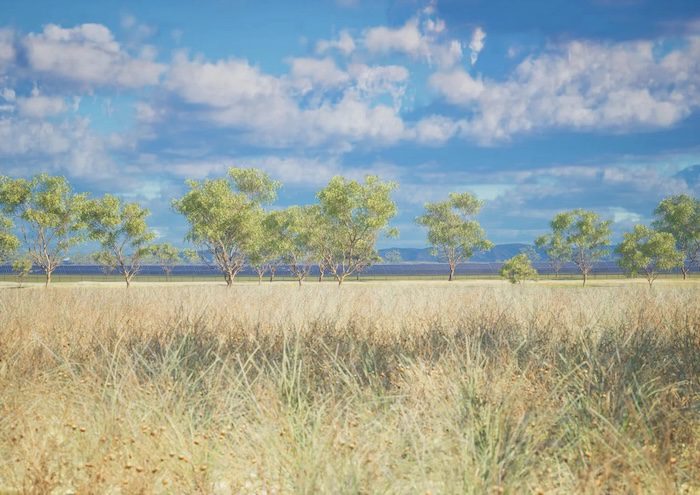
Nonetheless, certain sections in the south-western area remain relatively untouched since the late 1990s, currently hosting mature regrowth woodlands dominated by native Eucalyptus and Melaleuca species. Environmental surveys indicated the presence of remnant woodlands covering 758.1 ha of the total project area, alongside regrowth woodland occupying an additional 438.3 ha.
Among these areas, one patch of woodland has been classified as having endangered flora, while four others are noted as ‘of concern’. One of the major environmental considerations is the potential impact on the Calliope River, located 500 metres to the north, which feeds into the Great Barrier Reef. However, the developer maintains that the solar project will not adversely affect the reef, given its 19 km distance from the coastline and the implementation of diversion measures to prevent sediment runoff from entering the river and subsequently the ocean.
For those interested in keeping up with the latest developments in clean energy, over 29,000 individuals have subscribed for free daily updates. Sign up to stay informed!