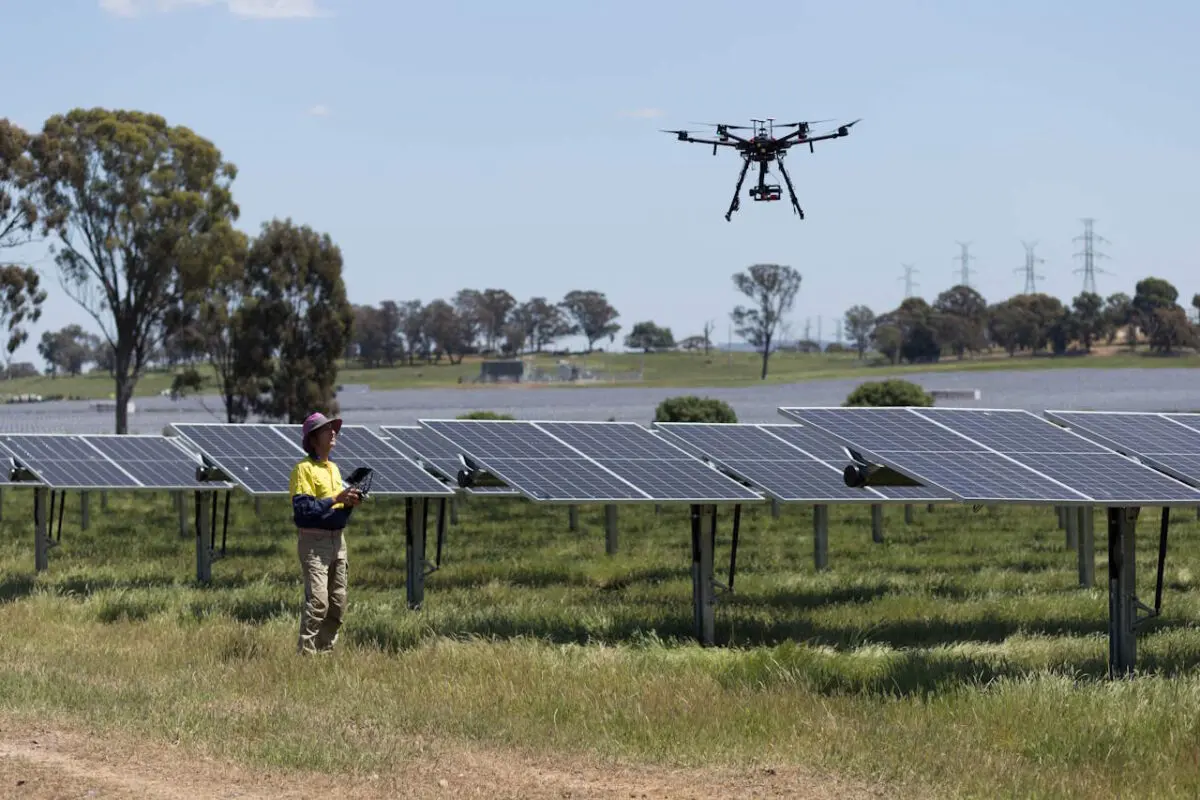
Federal Funding Boosts Drone Solar Inspection Technology in Australia
The Australian Renewable Energy Agency (ARENA) has pledged nearly $4 million to back innovative drone-based solar inspection technology developed at the University of New South Wales (UNSW). This cutting-edge technology promises to revolutionise the monitoring of large-scale solar farms.
This drone technology is pivotal for harnessing Daylight Photoluminescence (DPL) imaging, a method being refined by researchers at UNSW’s esteemed School for Photovoltaic and Renewable Energy Engineering. Unlike traditional luminescence imaging, which typically requires controlled lab environments, DPL imaging offers a more practical solution for the swift and cost-effective assessment of extensive solar installations.
Commercialising DPL Technology
A new start-up, Lab 360 Solar, established in early 2024, has secured exclusive rights to key DPL patents from UNSW. The company aims to commercialise this technology by integrating it with readily available drones. DPL imaging is designed to detect faults and damage in solar panels that other inspection techniques might overlook, providing insights down to the level of individual cells.
Moreover, DPL imaging is not only more precise but also more economical and user-friendly compared to conventional methods, which often necessitate additional equipment, personnel, and off-site evaluations.
Expert Insights on the Technology
Thorsten Trupke, CEO of Lab 360 Solar, remarked, “Our drone-based Daylight Photoluminescence technology is the culmination of over twenty years of dedicated research and development in luminescence imaging at UNSW. Once commercially launched, initially in Australia and subsequently worldwide, it will play a crucial role in ensuring that photovoltaic panels remain a dependable and sustainable element of the future energy landscape by facilitating improved monitoring, early fault detection, and long-term performance of solar assets.”
Trupke further emphasised that Australia, with its leading position in solar power adoption and ambitious net-zero goals, is ideally suited to pioneer and commercialise this groundbreaking innovation. “We are genuinely excited to contribute to the remarkable energy transition currently underway,” he added.
Support from ARENA
The advancement of DPL technology at UNSW has previously received support from ARENA-funded initiatives. Trupke highlighted that the latest funding from ARENA is crucial for launching Lab 360 and transitioning the technology from a proof-of-concept stage to fully operational commercial solutions.
Darren Miller, CEO of ARENA, noted, “Australia boasts world-class solar researchers and start-ups, yet their technologies often face challenges in moving from the lab to the market. Supporting promising innovations like Lab 360’s DPL technology is essential for demonstrating their value and scaling them into commercial solutions that benefit the entire industry. Investing early is vital to achieving our vision of Ultra Low-Cost Solar.”
Miller further explained that this technology has the potential to significantly lower the costs and complexities associated with solar farm diagnostics. By enabling early detection of issues and minimising the need for heavy equipment and labour, this innovation allows operators to maximise the efficiency of their solar panels, thereby supporting Australia’s clean energy future.
For those interested in staying updated on clean energy developments, over 26,000 subscribers receive a free daily newsletter with the latest news.