China’s Ambitious Solar Farm Features ‘Photovoltaic Sheep’
Chinese officials have proudly presented what they claim will be the largest solar farm in the world, situated on the Tibetan plateau and spanning an impressive 610 square kilometres, roughly the size of Chicago.
China has been rapidly expanding its solar panel installations, outpacing any other nation, and the results of this investment are beginning to show.
Positive Trends in Carbon Emissions
A recent study published on Thursday revealed that China’s carbon emissions decreased by one per cent in the first half of 2025 compared to the same period last year, continuing a downward trend that began in March 2024. This development suggests that the country’s emissions may have peaked significantly earlier than the government’s target of achieving this milestone before 2030.
Challenges Ahead for Carbon Neutrality
Despite being the largest emitter of greenhouse gases globally, China must implement more drastic reductions to contribute effectively to global climate change mitigation. To meet its ambitious goal of carbon neutrality by 2060, emissions must decline by an average of three per cent annually over the next 35 years, according to Lauri Myllyvirta, the lead analyst at the Centre for Research on Energy and Clean Air.
Myllyvirta emphasised the urgency of reaching this target, stating, “China needs to get to that three per cent territory as soon as possible.” Historically, emissions have dropped during economic downturns, but this time, electricity demand is on the rise, having increased by 3.7 per cent in the first half of this year. Fortunately, the growth in power generation from solar, wind, and nuclear sources has outstripped this demand.
Record Solar Capacity Installations
In the first six months of the year, China installed a staggering 212 gigawatts of solar capacity, surpassing the entire solar capacity of the United States, which stood at 178 gigawatts at the end of 2024. The study indicates that solar energy has now overtaken hydropower and is set to surpass wind energy this year, making it the largest source of clean energy in the country.
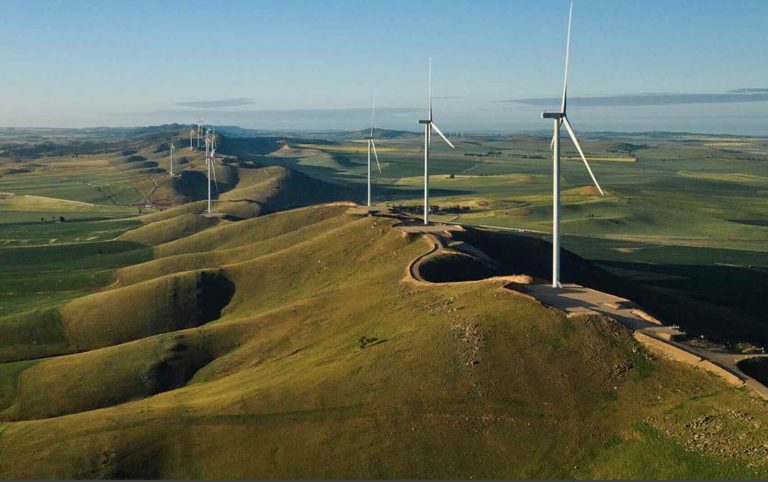
Additionally, 51 gigawatts of wind power were added during the same period. Myllyvirta noted that this represents a significant moment in the global climate narrative, providing a rare beacon of hope amidst a challenging climate landscape. He pointed out that it is indeed possible for a nation to reduce emissions while still experiencing economic growth.
Concerns Over Coal Dependency
However, Li cautioned that China’s continued reliance on coal poses a serious threat to its climate progress, urging a shift towards less resource-intensive sectors. “There’s still a long road ahead,” he remarked.
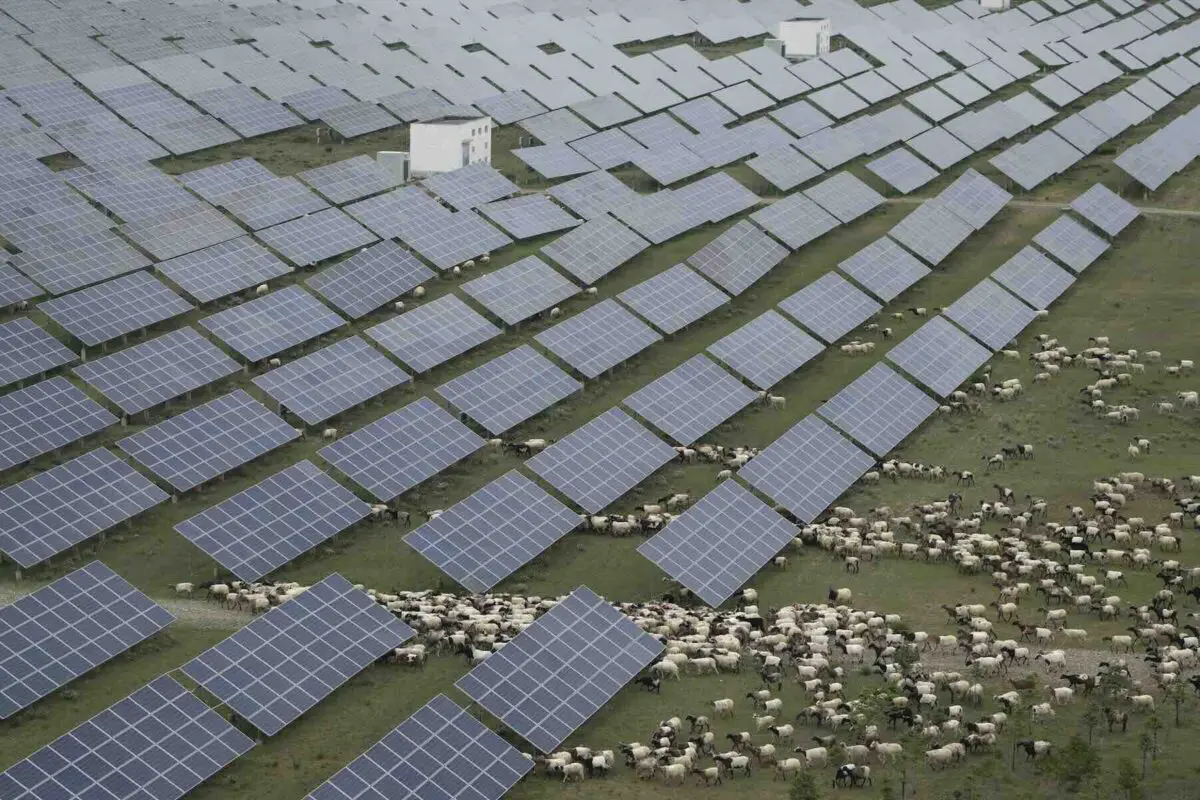
The vast solar farm on the Tibetan plateau features an endless array of solar panels stretching towards the horizon, with white two-storey buildings interspersed throughout. This massive project has transformed the arid landscape, as the panels serve as windbreaks, reducing dust and sand while slowing soil evaporation, thus allowing vegetation to thrive. Interestingly, thousands of sheep, referred to as “photovoltaic sheep,” graze contentedly on the scrubby plants beneath the panels.
A Sustainable Approach to Energy Production
Wang Anwei, the chief of the energy administration in Hainan Prefecture, described the project as a “win-win” situation. He explained that while enterprises generate electricity from the solar panels, the grass grows underneath, allowing villagers to herd sheep in the space between.
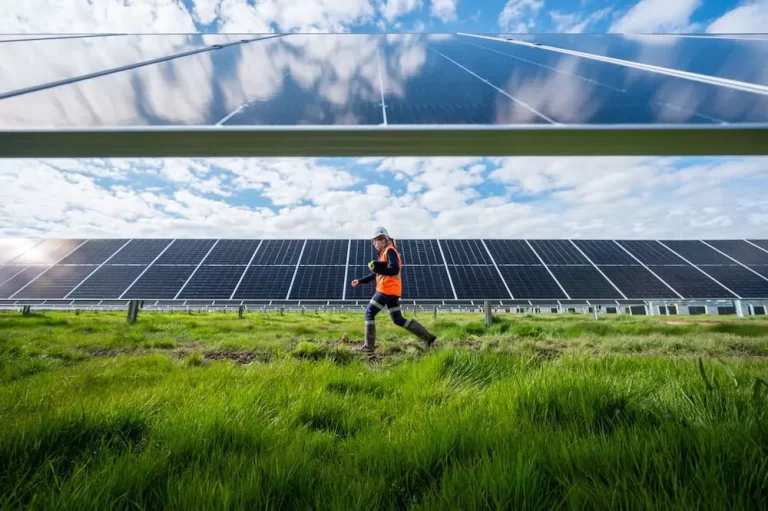
Currently, solar panels have been installed on approximately two-thirds of the land, with power already being generated from completed phases. Once fully operational, the project will feature over seven million panels, capable of supplying electricity to five million households.
Addressing Distribution Challenges
Like many of China’s solar and wind farms, this project is located in the sparsely populated western region of the country. A significant challenge remains in transporting this electricity to the densely populated eastern cities and industrial hubs. Zhang Jinming, the vice governor of Qinghai province, highlighted the misalignment between the distribution of green energy resources and the current industrial layout of the country.
To address this issue, plans are underway to construct transmission lines across the nation, including one linking Qinghai to Henan province and two additional lines planned to connect to Guangdong province in the southeast, nearly at the opposite end of the country.
However, the effective utilisation of this power is hampered by the rigid management of China’s electricity grid, which is designed for the steady output of coal plants rather than the more variable nature of wind and solar energy. Myllyvirta noted that while policymakers are aware of this issue and are working to address it, significant changes will be required in both the operation of coal-fired power plants and the transmission network.
“So it’s no small task,” he concluded.