Can Australian Solar Wafers Compete with Chinese Manufacturers?
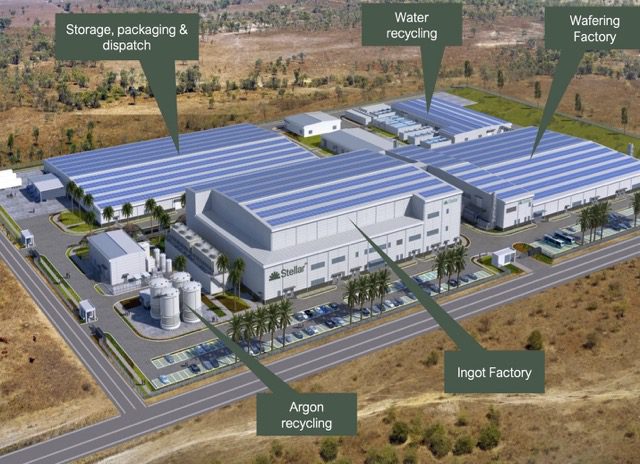
A $400 million factory set to be established in Townsville has the potential to produce 2 gigawatts (GW) of silicon wafers annually for solar panels, as indicated by preliminary findings from a federal renewable energy agency study. The insights showcase a government initiative aimed at positioning Australia to capitalise on opportunities within the vast solar industry supply chain, fostering resilience through local resources rather than relying solely on the Chinese photovoltaic (PV) market.
The study’s outcomes come as silicon wafer prices are on the rise due to China, which dominates 97% of the solar wafer production, eliminating unprofitable manufacturers. This price increase is expected to continue trending upwards this year.
Feasibility of Australian-Made Silicon Wafers
Last year, a study was commissioned to assess if a company named Stellar PV could feasibly produce silicon wafers locally. The verdict, delivered to the agency late last year and publicly available since last month, is a resounding yes.
The Australian Renewable Energy Agency (ARENA) funded this investigation as part of the $1 billion Solar Sunshot initiative, which aims to revive segments of the solar sector within Australia. Out of the total funding, $4.47 million has already been allocated to assist Stellar PV in securing a location near Townsville, identifying equipment suppliers, and initiating preliminary designs and cost assessments for a 2 GW ingot pulling and wafering facility whilst searching for potential buyers.
Next Steps for Project Clean Wafers
Stellar PV is now preparing for the next phase of the project, which entails a feasibility study and Front-End Engineering Design (FEED) to facilitate planning applications. This work is expected to wrap up within the year.
The company plans to utilise the Czochralski (Cz) method, a recognised global standard, which involves melting polysilicon into 500kg ingots, later shaping these into the blocks from which wafers are produced. They will manufacture a specific type of high-efficiency N-type wafer tailored to the specifications required by offtake partners.
Price Considerations for Local Production
A crucial consideration will be whether the advantages highlighted in the study, such as the elimination of hefty US tariffs on Chinese imports and enhancements in materials traceability and sustainability, will entice buyers to pay a premium for locally produced products.
According to Stellar PV’s findings, Australian-made wafers could remain competitive against less expensive Chinese counterparts thanks to production credits under the Solar Sunshot scheme. The report noted that comparable credits in the US reduced prices to around $US0.51 per wafer.
However, even at this rate, the cost is still more than twice that of Chinese-made wafers, which faced a price hike just recently, as per reports from PV Magazine Global.
Additionally, Chinese expertise will play a significant role in launching Australia’s first wafer manufacturing plant. Chinese firm KIDE has been tasked with the design and construction of the factory, following their past work with major companies including LONGi, Jinko, and JA Solar.
“Chinese specialists will assist in the technology rollout by travelling to Australia both in the short and long term, ensuring a transfer of expertise that will allow Stellar PV to swiftly enhance the skills of Australian personnel,” the report states. “Australia welcomes skilled migration for advanced manufacturing, and the Townsville region benefits from a flexible visa programme to sponsor overseas workers.”
Government Support Under Scrutiny
However, Stellar PV’s report does not address concerns from the Queensland government regarding projects outside the biomedical, defence, and biofuels sectors. Under the Crisafulli administration, initial funding for the significant green hydrogen initiative, known as the Central Queensland Hydrogen Project (CQ-H2), was withdrawn, along with support for a battery research commercialisation hub.
Although the report mentions Queensland’s backing for advanced manufacturing, it also stresses that the energy roadmap revealed last year “promotes affordable, reliable, and sustainable energy while attracting private investment in new generation and storage.” This assertion is challenged by the swift withdrawal of significant investments and a growing emphasis on gas and coal energy over renewable sources.
Challenges from the US Market
A component of the business case set out in ARENA’s study hinges on the US and its manufacturing capacity surpassing its own wafer production capabilities. Currently, the United States houses only two wafer manufacturers: Corning, whose 6 GW facility commenced operations in October 2025, and Q-Cells, which is constructing a 3.3 GW wafer line yet to begin production.
Much of the existing supply has already been pre-contracted, and several planned projects have been scrapped. For example, CubicPV cancelled a project in 2024 due to declining wafer prices and high construction costs within the US, while Norwegian firm Norsun has expressed uncertainty regarding its Tulsa, Oklahoma project, having previously withdrawn from various European initiatives.
Stellar PV anticipates a supply chain gap of 22 GW over the next few years that it could potentially fill.
The Biden administration’s Inflation Reduction Act (IRA) has previously sparked considerable growth in renewable energy, with solar panel manufacturing being a significant beneficiary. Although some IRA provisions supporting US solar production are being retracted, such as the investment tax credit, the effects of the substantial incentive package continue to resonate in the market.
According to the Solar Energy Industries Association, solar cell production capacity surged to over 60 GW from 2024 to late 2025. Nonetheless, policy shifts targeting clean energy technologies and random tariff threats from former US President Donald Trump present challenges to this expansion.