Australia’s First Solar-Powered Level Crossings Enhance Regional Rail
Two innovative solar and battery-powered level crossings have been launched in northern New South Wales, forming part of the ambitious Inland Rail freight link aimed at connecting Melbourne with Brisbane.
Touted as Australia’s largest project in freight rail infrastructure, the Inland Rail initiative represents a once-in-a-lifetime opportunity to link Melbourne and Brisbane through regional areas of Victoria, New South Wales, and Queensland.
Connecting Cities with Sustainability
Comprising 12 individual projects, the entire network will extend over 1,600 kilometres, providing a remarkable 24-hour transit time for freight moving between these two major cities upon completion.
The recent unveiling of the solar-powered level crossings coincides with the final stages of the Narrabri to North Star (N2NS) Phase 1 segment of the project.
First of Their Kind
One crossing is situated north of Moree, with the other located north of Narrabri. These crossings mark the inaugural solar-powered installations on the Inland Rail and by the Australian Rail Track Corporation (ARTC), the organisation responsible for operating and maintaining Australia’s national rail network.
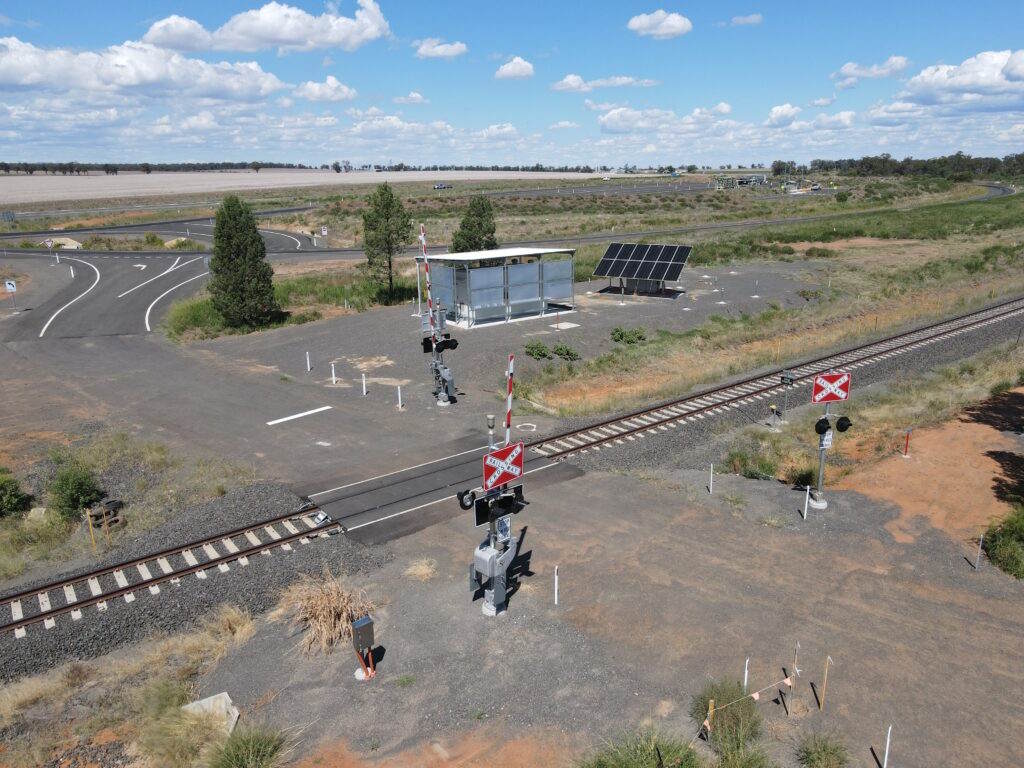
Transitioning from “passive” level crossings—typically marked by a ‘Stop’ or ‘Give Way’ sign that requires drivers to monitor for trains—these upgrades transform them into active crossings supported by a fully solar-powered standalone power system (SAPS).
Enhanced Safety and Efficiency
This upgrade represents a significant advancement and a promising development for the nation’s rail infrastructure. Conventional level crossings requiring automated boom gates and flashing lights usually depend on electricity from the grid along with battery backup systems.
While this setup is manageable in urban centres, the absence of reliable electricity infrastructure in regional and rural locations makes such crossings costly and complex to establish.
By implementing solar and battery-powered systems, Inland Rail has circumvented the need to tap into existing power sources or create new electrical installations, which in turn reduces land access requirements and lessens the impact on local landowners.
The newly installed solar-powered level crossings are equipped with high-intensity LED flashing lights, bells, and retro-reflective boom gates. Internal batteries ensure functionality during the night or in case of emergencies, while a communications setup facilitates remote monitoring and alerts for faults.
Future Developments in Solar Power
The ARTC has plans to roll out solar-powered signalling systems at various locations along the alignment to ensure a steady electricity supply once Inland Rail becomes operational.
A representative from Inland Rail highlighted, “Utilising solar-powered standalone power systems mitigates impacts on local communities, reduces the need for land clearing, and lowers the costs associated with Inland Rail.”