Australia Allocates $150 Million for Solar Supply Chain Development
The Australian government is turning its attention to local manufacturers of solar photovoltaic module frames, glass, junction boxes, and deployment technologies through the Solar Sunshot initiative, which is now offering $150 million in funding as part of its second round of a $1 billion scheme.
On Thursday, Federal Energy Minister Chris Bowen announced that submissions for Round 2 of Solar Sunshot will commence on September 23, marking a significant advancement in the Albanese government’s Future Made in Australia strategy.
Focus on Solar Supply Chain
Similar to the previous rounds, Round 2 will be managed by the Australian Renewable Energy Agency (Arena) and aims to extend financial support to various segments of the solar supply chain. Bowen stated, “Solar Sunshot is all about producing more of the clean energy technology we require right here in Australia.” He added that the success of Round 1 demonstrates that with adequate support, Australian firms can enhance their solar manufacturing capabilities.
Bowen emphasised that Round 2 will specifically target essential components of the supply chain to foster resilience, security, and job creation.
Background of the Solar Sunshot Policy
The Solar Sunshot policy was initially unveiled by Federal Labor in March 2024, pledging $1 billion in production subsidies and grants to establish a solar supply chain within Australia. Prime Minister Albanese remarked that Australia should not merely be the final link in a global supply chain built on an Australian innovation, a sentiment he expressed during a speech at the recently decommissioned Liddell coal-fired power station in New South Wales.
Round 1A, which launched in September 2024 and has since closed, allocated up to $500 million for module manufacturing, while Round 1B reserved $50 million for feasibility and engineering studies, with an extension until November 2026.
Funding Recipients and Future Prospects
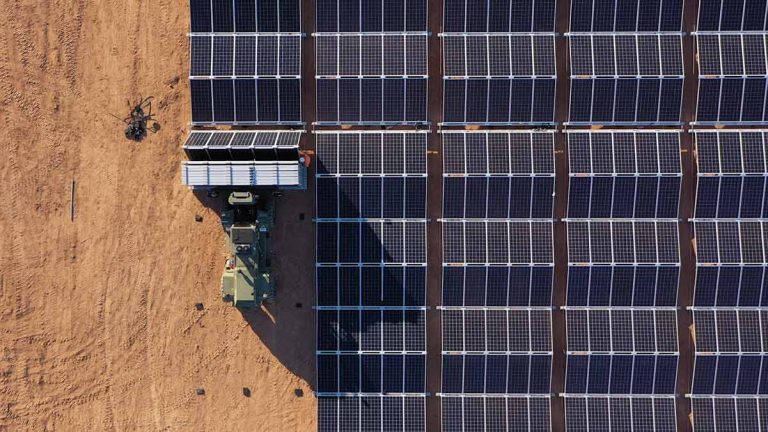
In May, 5B, an Australian innovator known for its rapid-deploying technology, became the first recipient of Round 1 funding, receiving $46 million to boost production of its Maverick solar units at its Adelaide facility. Last month, Tindo Solar, Australia’s sole PV panel manufacturer, was granted $34.5 million to upgrade and increase production at its Mawson Lakes factory in South Australia, as well as to expand its offerings to include premium N-type modules.
Round 1B has also seen a total of $11 million awarded for three feasibility studies aimed at upstream solar manufacturing. This includes $4.7 million allocated to Stellar PV for exploring the construction of a 2 GW low-emissions polysilicon ingot pulling and wafering facility near Townsville, Queensland. Additionally, Solquartz received $5 million for its feasibility study into a 100,000 tpa low-emission, solar-grade polysilicon production facility, also in Townsville. In New South Wales, Energus was awarded $1.3 million for a study on a 50,000 tpa low-emissions, solar-grade polysilicon production facility at AGL’s Hunter Energy Hub.
Strategic Vision for Solar Manufacturing
The second round of funding, with its $150 million allocation, will focus on segments of the PV supply chain such as framing, solar glass, junction boxes, and deployment technologies. This strategic shift aligns with Arena chief Darren Miller’s perspective that establishing a foothold in global solar manufacturing is not solely about producing panels and certainly not about competing with China.
Miller stated, “We need to play a meaningful role in the supply chains,” emphasising that while Australia does not need to handle every aspect independently, it should identify areas where it can excel and become a reliable partner. He reiterated this belief, asserting that Australia has the potential to manufacture high-quality products across the solar PV supply chain.
Despite currently having limited production capabilities, Miller believes Australia possesses the necessary skills, partnerships, and raw materials to build a robust foundation for solar manufacturing over the next decade.